Construction site security in Dallas–Fort Worth: guards, patrols, cameras or a trailer?
October 2, 2026 · SiteFortress360
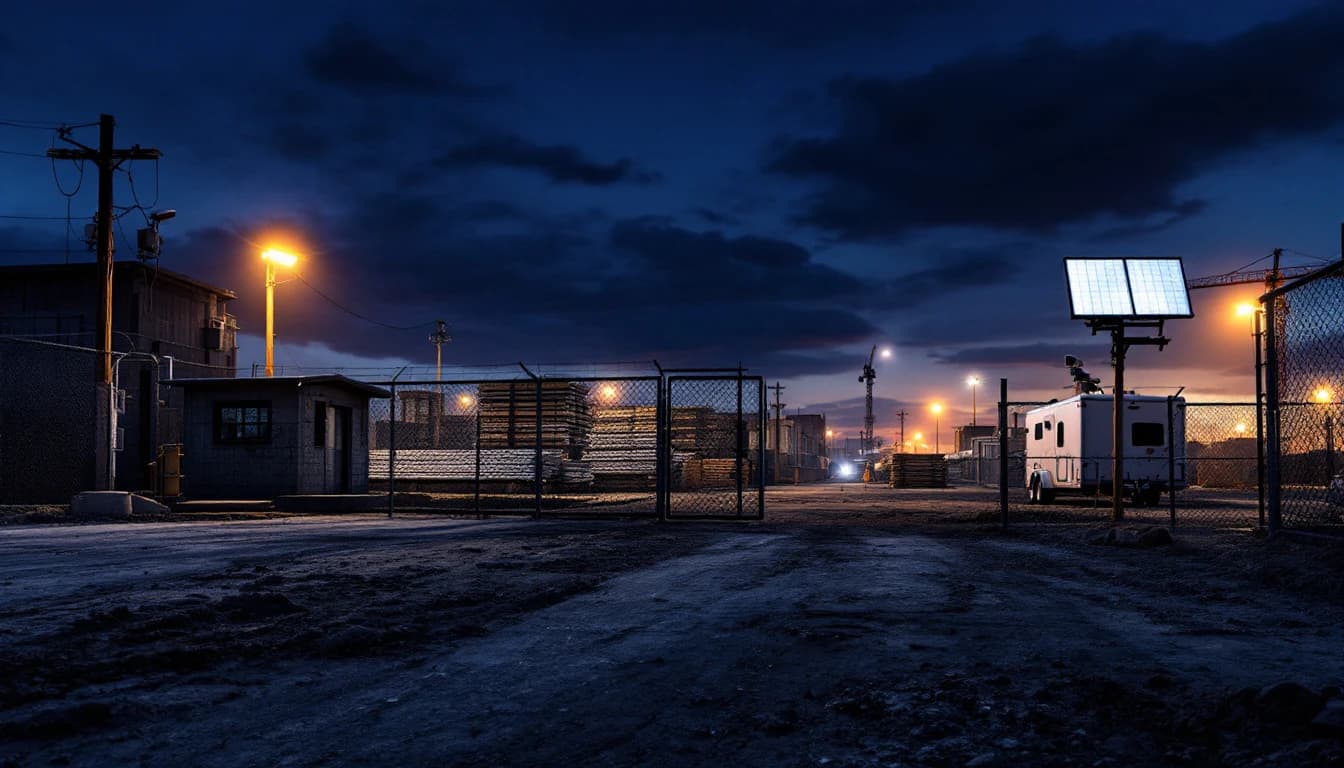
Direct answer: Dallas–Fort Worth contractors have five realistic options: a standing overnight guard, a mobile patrol that drives through, fixed cameras on temporary power, a monitored alarm on the tool container, or a solar surveillance unit. Guards win where somebody must physically control access. Patrols are the cheapest and the thinnest. A solar unit — $695 to $1,695 per month from SiteFortress360 — wins on unpowered sites that need continuous coverage and a record of what happened. Most well-run sites combine two.
Start with the job the security has to do
Every security option on a jobsite does some mix of four jobs: it deters, it detects, it responds, and it documents. The reason contractors end up disappointed is almost never that they bought a bad product. It is that they bought something that does two of those jobs and assumed it did all four.
A guard deters and responds, detects only what is in front of them, and documents almost nothing. A patrol deters a little and checks locks. A camera system detects and documents continuously and deters when it is visible and loud, but it cannot put a hand on a gate. Once you sort the options by which jobs they actually do, the right combination for a particular site is usually obvious — and it is usually a combination.
The comparison below is written for the person holding the general conditions budget on a DFW project. Where a number is ours, it is the published rate. Where it belongs to somebody else, it is given as a range and you should get it quoted, because guard and patrol pricing in this market varies widely by company and by contract length.
Option one: a standing guard
A guard on post is the oldest answer and still the right one for a specific job: controlling who comes through a gate. If your site needs someone to check a delivery against a ticket, turn away a vehicle that should not be there, sign subcontractors in or walk an inspector to the right floor, no camera does that. This is where a guard earns the money, and it is mostly a daytime job.
Overnight is where the arithmetic gets difficult. At prevailing DFW guard rates of roughly $20 to $35 or more per hour once the contractor’s markup is loaded in, a single 12-hour night post runs well north of $6,000 per month. That buys one person who can look in one direction at a time, on a site that may be several acres, through the hours when attention is hardest to sustain. It also buys no record: if something is taken from the far side of the building, what you have the next morning is a written report that nothing was observed.
The honest summary is that a guard is the best tool for access control and physical presence and an expensive tool for watching empty ground in the dark. Many larger DFW sites settle on exactly that split — a guard at the gate during working hours, and something else covering the site overnight.
Option two: a mobile patrol
A patrol service sends a marked vehicle through the site a set number of times a night. It is the cheapest line item on this list, it is typically priced per visit or per night, and it varies enough between providers that the only useful number is a quote.
What a patrol genuinely does well is verification: confirming the gate is chained, the container is locked and the temporary fence has not been opened. It is also a reasonable way to get a human response to an alert from some other system. What it cannot do is watch. Between visits the site is unobserved, and the visits themselves are short and easy to wait out. Anyone who has watched a site for an evening knows roughly when the car comes.
Patrols make sense as a supplement — a physical check and a response arm — and rarely as the whole plan on a site holding anything worth a truck and twenty minutes.
Option three: fixed cameras on temporary power
Conventional cameras are excellent once a building can host them. They need three things a jobsite does not have for most of its life: power, a network connection and something permanent to mount on. During clearing, grading, foundations and structure there is usually none of the three anywhere near the laydown yard, and temporary power poles are themselves a favorite thing to cut.
Later in the job the picture changes. Once the building is dried in and has house power, fixed cameras inside it are the right tool for the finishes phase, when the targets are appliances, fixtures and installed equipment behind walls a mast camera cannot see through. And on a finished property that will be occupied for years, a permanently installed system is the correct long-term answer. A relocatable unit is a bridge to that system, not a replacement for it.
Option four: a monitored alarm on the tool container
A door contact and a motion sensor on a storage container or office trailer, reporting to a monitoring center, is cheap and worth having. It protects the single place where the most portable value on the site is concentrated, and it does that job well.
Its limit is the box itself. It knows nothing about the excavator, the fuel tank, the copper staged for rough-in or the truck backing up to the material stack. It also produces a signal rather than a picture, which matters for response: many DFW cities require a permit for a monitored alarm and bill for repeated false alarms, so check the rules in the city where the site sits. Treat a container alarm as protection for the container and plan the rest of the site separately.
Option five: a solar surveillance trailer or tower
A solar unit exists for the phase of the job when nothing else can be installed. It brings its own power from solar panels and a battery bank, its own LTE connection, its own mast and its own recording, so it works on a bare pad on day one. On-board AI separates people and vehicles from wind and headlights, alerts go to your phone with a snapshot and a clip, video is recorded locally on the unit so a dropped signal does not cost you the footage, and a siren and strobe give it a voice.
SiteFortress360 publishes the price: $695 per month for the Mini portable tower with four cameras at 10 to 12 feet, $995 per month for the SiteFortress 360 trailer with four cameras at 18 to 20 feet, and $1,695 per month for the PTZ Pro, which adds a pan-tilt-zoom camera to the four fixed ones. A one-time deployment fee of $299 to $699 is waived on a 6-month agreement.
Now the limits, because they are real. A unit cannot physically stop anyone and cannot check a delivery ticket. It needs sight lines and sun, so it does not see inside a closed building or behind a stack that went up after it was placed. And an alert is only as good as what happens next: on the base configuration that is you or your superintendent looking at a phone. If nobody is going to look at two in the morning, the 24/7 Live Monitoring add-on, from $499 per month, is what turns a detection into a response.
- Wins on unpowered, unconnected ground — which is most of a project’s life
- Watches every direction continuously and keeps the record
- Costs a fraction of an overnight guard post
- Loses to a guard on access control and physical intervention
- Loses to fixed cameras inside a finished, powered building
What Dallas–Fort Worth changes about the decision
Three things about this market tilt the comparison. The first is sprawl. Census Bureau building permit data has put Dallas–Fort Worth at or near the top of US metros for new housing for years, and a large share of that work happens on greenfield land at the edge of the Metroplex. Those sites are the furthest from power, the weakest on cellular signal and the longest drive for a patrol car or a police unit. That is the environment a self-powered unit was designed for, and it is why a Starlink option exists at $100 per month for sites where LTE is thin.
The second is scale. Subdivision phases, tilt-wall distribution buildings and multifamily projects here commonly spread equipment and materials across a lot of ground, and one guard post covers less of it than people assume when they sign the contract.
The third is distance to us. SiteFortress360 deploys within a 50-mile radius of Arlington, which takes in the core of the Metroplex. If your site is outside that circle we are not your answer, and a provider who says yes to everything regardless of distance is worth a second question about how quickly they can actually reach the unit when it needs service.
How to choose: four questions
You can get to the right combination for most sites by answering four questions honestly, in order.
The combinations that come out of those answers are consistent. A day guard at the gate with an overnight unit. A container alarm protecting the tools with a unit watching the yard and the machines. A unit from mobilization through rough-in, handing over to fixed cameras once the building has power. None of those is exotic, and each one costs less than the single overnight guard post it usually replaces.
- Is there power and a network connection where the value sits? If not, fixed cameras are out for now.
- Does somebody need to physically control who enters? If yes, that is a guard, for those hours.
- What is on site overnight, and what would one bad night cost in replacement and schedule?
- How long will the site be exposed? Six months or more waives the deployment fee on a unit.
Questions to ask any provider before you sign
Whichever option you lean toward, the same handful of questions separates a provider you can plan around from one you will be chasing. Is the price published, or does it appear only after a sales call? What exactly is included in the monthly figure, and what is billed on top of it? What happens when the guard does not show up, or the camera goes offline — who finds out first, you or them? Who responds to an alert, and within what stated plan? And what is the minimum term, and what does leaving early cost?
We publish our answers because we think the comparison should be possible without a meeting. If a guard or a permanent system is the better fit for your site after reading this, that is a good outcome too: the worst result is paying for something that was doing a different job from the one you needed.
Frequently asked questions
What is the cheapest way to secure a construction site in Dallas–Fort Worth?
A mobile patrol or a monitored alarm on the tool container is the lowest monthly cost, and each does one narrow job: checking locks, or protecting one box. The cheapest way to cover the whole site continuously is a solar surveillance unit, which starts at $695 per month for the SiteFortress Mini. Cheapest and sufficient are different questions, so price the option against what is on site overnight.
How much does a construction site security guard cost in DFW?
Prevailing rates run roughly $20 to $35 or more per hour once the guard company’s markup is included, so one 12-hour overnight post comes to well over $6,000 per month. Rates vary by company, contract length and whether the guard is armed, so treat that as a planning range and get it quoted. Bureau of Labor Statistics wage data for security guards is a useful sanity check on any quote.
Do I still need a guard if I have a surveillance trailer?
Only if the site needs something a camera cannot do, which usually means access control: checking deliveries, signing people in, turning vehicles away. That is mostly daytime work. Overnight, when the job is watching empty ground and keeping a record, a unit does it for a fraction of the cost. Many larger sites run a day guard at the gate and a unit overnight.
Can I just install regular security cameras on a jobsite?
Not until the site can host them. Conventional cameras need power, a network connection and a permanent mounting point, and a jobsite has none of those near the laydown yard for most of the build. They become the right tool once the building is dried in with house power, especially for the finishes phase, and on the finished property long term.
Does a surveillance unit work on a site with no power or internet?
Yes, that is what it is built for. Each unit generates its own power from solar panels and stores it in a LiFePO4 battery bank, connects over included LTE, and records locally so footage survives a signal drop. For sites on the rural edge of the Metroplex where cellular coverage is weak, Starlink connectivity is available as an add-on at $100 per month.
How far from Arlington does SiteFortress360 deploy?
Within a 50-mile radius of our Arlington hub, which covers the core of the Dallas–Fort Worth Metroplex. Delivery, placement, camera positioning, detection-zone setup and onboarding inside that radius are covered by the one-time deployment fee, which is waived on a 6-month agreement. Outside the radius we would rather say no than promise service we cannot reach quickly.