Construction site security, phase by phase
August 30, 2026 · SiteFortress360
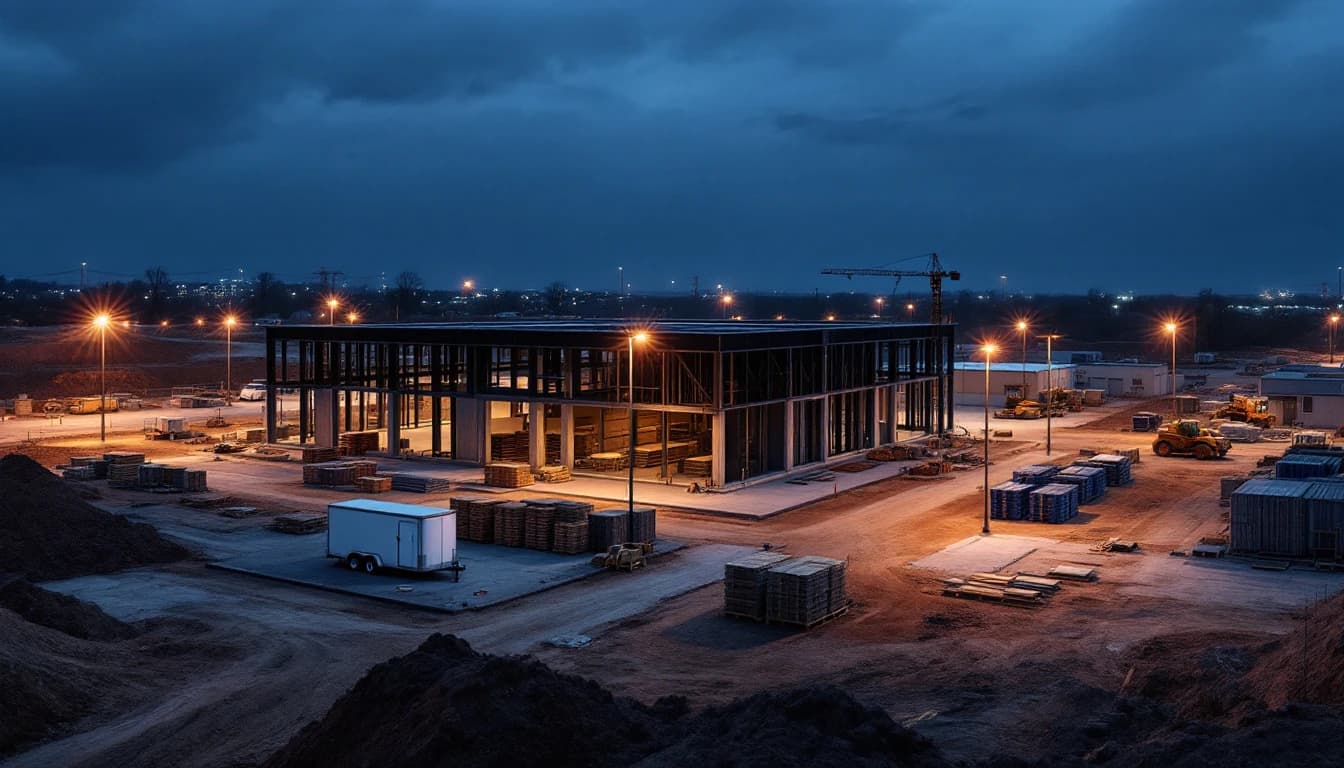
Direct answer: Jobsite security is not one decision, it is five, and they change with the build. Mobilization protects equipment and the laydown yard. Structure protects fuel, generators and materials. Rough-in is the copper window and the highest-loss phase on most DFW commercial jobs. Finishes move the target indoors to appliances, fixtures and tools. Turnover leaves a finished, valuable, unstaffed building. One relocatable unit covers all five — but only if somebody moves and re-aims it.
Phase 1 — Mobilization and sitework
The first month is the most exposed month and it is the one most often left uncovered. Temporary fencing is up but incomplete, the gate is whatever the last subcontractor left it as, there is no permanent lighting, no power and no internet — and the most portable, most resaleable assets on the entire job are sitting on a bare pad: skid steers, mini excavators, light towers, fuel and a gang box or two.
What this phase needs is coverage of the laydown area and the approach, not the building, because there is no building. One unit positioned so its sight lines cover equipment parking and the main entrance does more than three cameras aimed at a pad. This is also the phase where the whole argument for an autonomous unit lives: it works before the site has anything to plug into.
- Cover the equipment laydown and the gate approach before anything else
- Expect drive-up opportunity crime in the small hours, not sophisticated entry
- Deterrence outweighs detail here — light, sound and obvious presence
- Confirm the unit sees the approach, not only the assets
Phase 2 — Foundation and structure
Once concrete and steel start, the site fills with things that are heavy, valuable and slow to move — which changes the risk profile rather than removing it. Fuel becomes the standing target: equipment tanks and on-site tanks get drained on repeat schedules, often by people who have already been on the site legitimately. Generators, compressors, formwork, rebar and scaffolding all walk.
Coverage should still be wide in this phase, but the unit usually wants to move. The laydown yard has shifted, the crane has changed the geometry of the site, and the position that made sense on a flat pad now stares at the back of a wall. Re-aiming after a phase change is the single most-skipped maintenance step on a jobsite security deployment.
Phase 3 — Rough-in is the copper window
This is the phase that funds most jobsite theft losses. Between electrical rough-in and trim, a building holds more accessible copper than at any other point in its life: wire pulled and staged, conduit, spooled remainders, panels and HVAC line sets. It is light, it is anonymous, it converts to cash the same week, and the building is now enclosed enough that somebody working inside it is invisible from the street.
The coverage move here is counter-intuitive. You often want the unit closer to the building and aimed at the openings — door bucks, loading points, the side where the dumpster sits next to the weak run of fence — rather than parked centrally covering everything at once. Wide coverage stops being the priority the moment the target moves inside walls.
The loss also compounds in a way the material invoice never shows. Stolen wire is the copper, plus the re-pull labor, plus the schedule slip, plus whatever finished work had to be opened to get at it.
- Stage wire in the smallest quantities the schedule allows
- Aim coverage at openings and the route to the fence, not the footprint
- Treat the dumpster area as an exit path, because that is what it is
- Assume anyone on site after dark already knows where today’s wire was staged
Phase 4 — Finishes move the target indoors
Appliances, fixtures, rooftop HVAC units, water heaters, cabinets and finish hardware arrive on a schedule every person on the job can read. Rooftop units get stripped for copper. Tools stay in the building overnight because the crew is coming straight back in the morning. The building now locks, which creates a dangerous kind of comfort — a lock keeps honest people out and slows nobody else down for long.
By this phase the useful camera positions are perimeter and access: which vehicles came into the lot, which door opened, who walked the rear of the building at 2 AM. This is where License Plate Recognition at the gate starts earning its +$199 per month on sites with real vehicle traffic, because a plate event attached to a timestamp is the piece of evidence police and insurers actually ask for.
Phase 5 — Punch, turnover and the empty-building gap
The most under-protected weeks on many projects are the ones after substantial completion. Crews are gone, fencing comes down, the security line item closed with the schedule, and the result is a finished, valuable, unstaffed building full of new equipment that nobody visits until the tenant does. Copper theft in a completed building costs far more than in rough-in, because now it destroys finished work on its way to the wire.
Keep coverage through turnover rather than through completion. It is usually one additional month on a unit that is already on site, not a new deployment, and it protects the phase where a loss is most expensive to repair and most visible to the client.
What this costs across a whole build
Price the project rather than the month and the decision gets simple. A ten-month DFW build carrying a SiteFortress 360 at $995 per month is roughly ten thousand dollars of security line item across the entire job — typically a fraction of one percent of the contract value it protects, and less than two months of a single overnight guard post at prevailing local wages. The six-month agreement waives the deployment fee, and almost every commercial schedule clears six months without effort.
The number that never reaches an invoice is the one worth staring at. A single stolen skid steer, one stripped copper rough-in or a weekend of fuel theft routinely exceeds a full year of unit rental, and national equipment recovery rates stay stubbornly low — which is why the comparison that matters is never unit-versus-nothing but unit-versus-the-loss.
The move most sites forget
Every phase change is a coverage change. When the laydown yard moves, when the building encloses, when the fence line shifts for paving, when the gate relocates for the final drive — the position and aim that were correct last month are now approximately correct, which on a security system means wrong.
Repositioning is part of the service on a rental for exactly this reason: the trailer tows, the Mini moves by forklift, and every move ends with cameras re-aimed and detection zones redrawn. If you take one operational habit from this guide, make it this — add a security walk to the same checklist that already tracks your phase transitions, and confirm the unit still sees what matters now rather than what mattered at mobilization.
Frequently asked questions
When should security go on a construction site?
At mobilization, before the first machine stays overnight. The gap between equipment arriving and security arriving is where the cheapest and most preventable losses happen, and it is a gap created by the ordering process rather than by budget — the unit gets ordered after somebody notices the site is exposed. Autonomous units exist specifically because that first month has no power, no internet and no permanent infrastructure to build on.
Which construction phase has the highest theft losses?
Electrical rough-in through trim on most commercial jobs. That window combines the maximum quantity of accessible copper with a building enclosed enough to conceal somebody working inside it. The loss compounds too: stolen wire is not only the material but the re-pull labor, the schedule slip and, in finished areas, the drywall and trim destroyed on the way to it.
Does the unit have to move as the project changes?
Usually yes, at least once, and the moves are cheap compared with the coverage they buy. A position chosen to watch an open pad rarely still covers the right ground once the structure is up and the laydown yard has relocated. Repositioning is part of the rental service: the trailer tows, the Mini moves by forklift, and every move ends with cameras re-aimed and detection zones redrawn.
Can one unit cover an entire jobsite?
One well-placed unit covers most single-building DFW sites from an 18 to 20 foot mast, which is why the SiteFortress 360 is the common recommendation at $995 per month. Large multi-building projects, long linear sites and anything with blind geometry usually need a second unit or the PTZ Pro, whose zoom camera inspects detail at distance while four fixed cameras hold quadrant coverage.
Do we still need fencing and lighting if we have a surveillance unit?
Yes. Fencing, lighting and site controls are the base layer, and an active construction site carries its own federal safety obligations around them regardless of what security you add. Surveillance is what tells you the base layer has been defeated, records what happened and puts deterrence on the site at the moment of the attempt. The layers do different jobs and neither substitutes for the other.
What about theft by people who are supposed to be on site?
It is a real and uncomfortable share of jobsite loss, and it is the case where recording matters more than deterrence. A strobe does not deter somebody with a legitimate reason to be there. A timestamped record of who entered, when, and what left with them does — which is also why plate capture at the gate tends to change behavior quickly on sites with heavy subcontractor traffic.