Solar surveillance trailer vs security guard
August 13, 2026 · updated August 29, 2026 · SiteFortress360
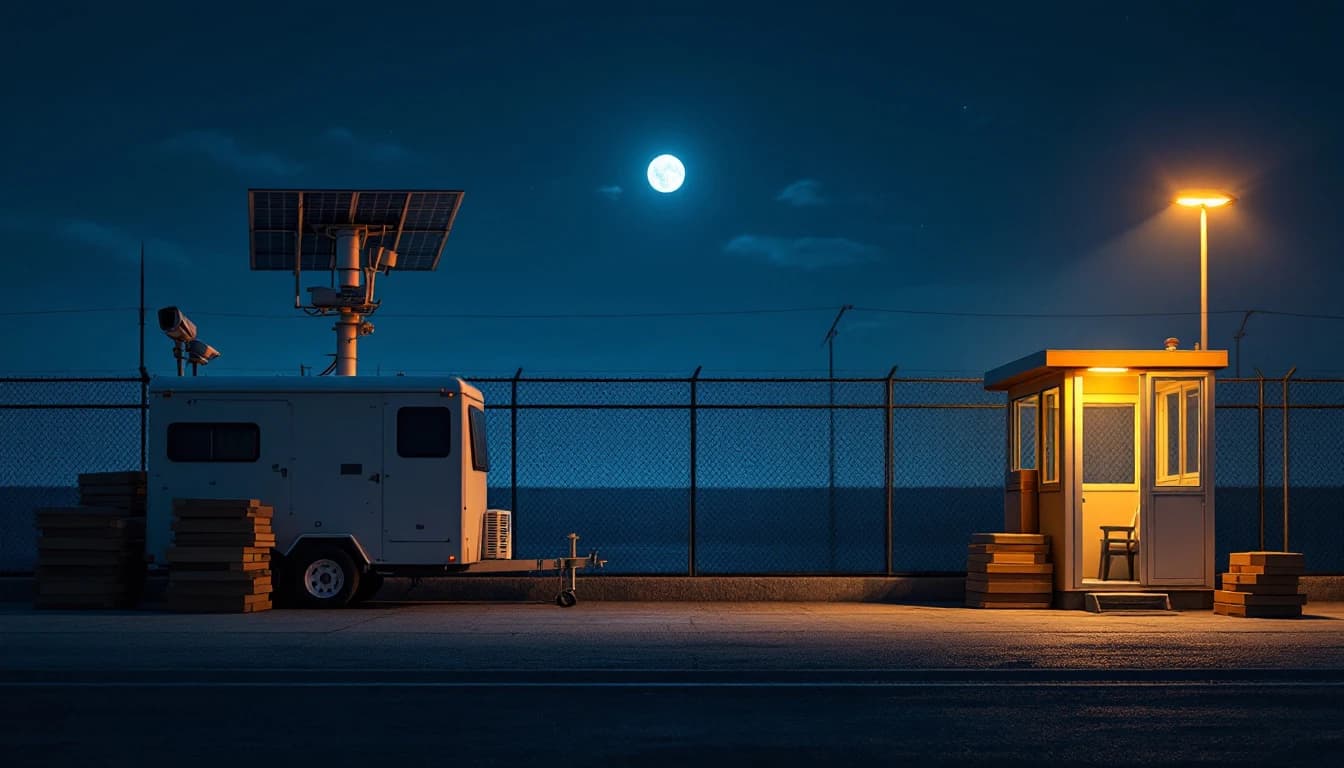
Direct answer: A single overnight guard post in DFW typically costs $6,000–$10,000+ per month and covers wherever one person is looking; a solar surveillance unit costs $695–$1,695 per month, watches 360° continuously, records everything, and never misses a shift. Guards still win where physical intervention, access control or customer interaction is the actual job.
The honest math
Guard pricing is hourly, so nights and weekends multiply fast: 12 hours a night at a loaded $22–$35/hour is roughly $8,000–$12,700 per month for one post — before holidays, turnover, and the supervision needed to confirm the post is actually manned and awake. A surveillance unit is a flat monthly rate a tenth of that size.
Coverage is the less obvious gap. A guard sees one direction, walks one route, and is human — attention fades at 3 AM, exactly when incidents cluster. Four cameras with edge AI watch every direction simultaneously with the same vigilance at hour one and hour nine, and everything they see is recorded.
What each does better
The unit wins on: continuous 360° coverage, perfect attendance, evidence (every event recorded with timestamps), deterrence at machine speed (strobe/siren the moment a person enters a zone), cost, and equipment that reports its own health.
A guard wins on: physical intervention, complex judgment calls (escorting visitors, checking credentials, handling deliveries), customer-facing presence, and tasks that are really operations rather than security. If the job description includes opening gates for vendors, a camera is not the answer — though gate control plus a unit sometimes is.
The hybrid most large sites land on
Big projects often keep a day guard for access control and replace the overnight post with a monitored unit: AI detection, human verification through the monitoring workflow, and voice-down deterrence. That configuration covers the vulnerable hours at a fraction of double-post cost — and produces better evidence than a lone guard with a phone.
One more factor experienced supers mention: a recorded talk-down (“You on the yellow excavator — you are on camera and being recorded”) is often more effective than a lone guard confronting a crew, and it puts no employee at physical risk.
The attendance problem nobody prices in
Guard economics assume the post is actually manned, and industry turnover makes that a live question every week. Contract security runs some of the highest turnover of any sector — replacement posts get filled by whoever is available, site familiarity resets to zero, and no-shows on holiday weekends cluster exactly when theft does. Supervising the supervision becomes its own cost: someone has to confirm the guard is present, awake and walking the route they log.
A unit has no attendance to manage. Its uptime is telemetry — battery state, camera health, connectivity — visible to the operator continuously, with maintenance dispatched on data instead of on complaints. That difference does not appear on either quote, and it is frequently the deciding factor for superintendents who have managed both.
None of this is a criticism of the people doing guard work — it is a criticism of asking one human to do a job that is structurally about constancy. The floors of the guard industry are set by economics nobody at the post controls, and the turnover follows from them. The comparison is between models, not between a machine and a person, and the model that never blinks wins the overnight shift on the merits.
Frequently asked questions
How do I compare quotes between a guard company and a camera unit fairly?
Put both on the same page as monthly cost per covered hour, then add the lines the quotes omit. For the guard: turnover and retraining, supervision to confirm the post is manned, holiday premiums, and the coverage gap while one human patrols one route. For the unit: the add-ons your site would actually use, such as monitoring or LPR. Then ask each side the same question — what evidence exists after an incident at 3 AM? — and weigh the answers against what your insurer and your disputes actually require.
Is a camera trailer really cheaper than a security guard?
For overnight coverage, dramatically: one 12-hour night post at loaded DFW rates of $22–$35 per hour runs roughly $8,000–$12,700 per month for a single human watching one direction, while a surveillance unit runs $695–$1,695 per month watching 360° continuously and recording everything. The gap widens once you add guard turnover, supervision and holiday coverage — costs that never appear on the security company’s quote.
When is a security guard actually the better choice?
When the real job is something a camera cannot do: physically intervening, checking credentials, escorting visitors, receiving deliveries, opening gates for vendors, or any customer-facing presence. Those are operations tasks wearing a security uniform. If your post orders read like a receptionist-plus-doorman role, keep the human — and consider covering the empty overnight hours with a unit instead of a second shift.
What is the hybrid setup large sites use?
A day guard for access control and operations, and a monitored surveillance unit for nights and weekends. The unit’s AI detection feeds a monitoring workflow with human verification and voice-down deterrence, covering the statistically vulnerable hours at a fraction of a second post’s cost — and producing recorded evidence a lone overnight guard rarely captures. It is the configuration most big DFW projects land on after trying each alone.
Can a trailer actually deter a theft crew the way a guard can?
Often better, and with nobody at risk. A recorded talk-down naming what the crew is doing — ‘you on the yellow excavator, you are on camera and being recorded’ — reliably ends the visit, because it proves identification is already happening. A lone guard confronting a multi-person crew at 3 AM is a safety incident waiting to happen; a speaker, strobe and siren escalate at machine speed without creating one.
Do insurance carriers treat cameras and guards differently?
Carriers care about documented loss control, and both approaches can qualify — but recorded, timestamped video of every after-hours event tends to serve claims and disputes better than a guard’s log entry. Ask your carrier what documentation they credit; several DFW builders adopted units after a claims process where the deciding evidence was footage, not testimony. This is worth a ten-minute call before renewal either way.