Can a surveillance trailer be stolen or disabled?
October 2, 2026 · SiteFortress360
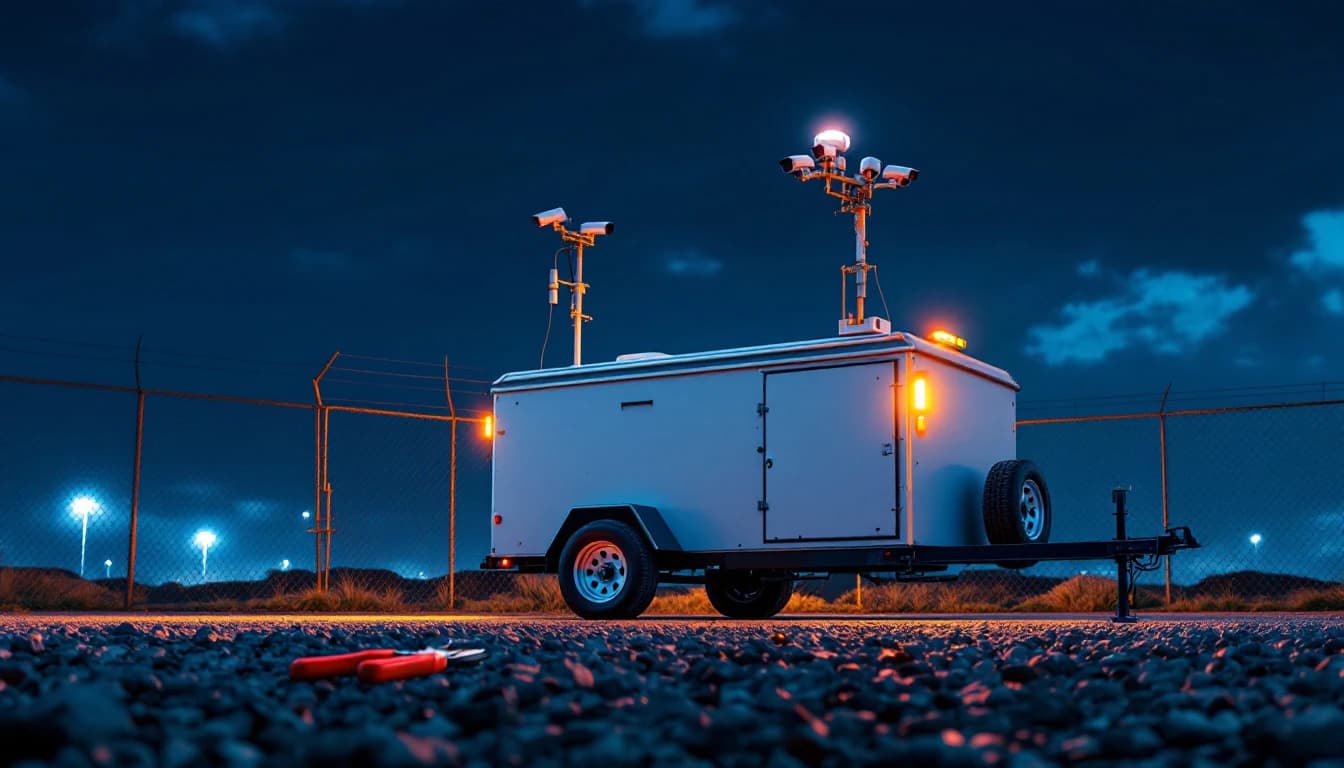
Direct answer: It can be attacked, and a well-designed unit assumes somebody will try. There is no power cable or network cable to cut, video is recorded on the unit so losing signal does not erase evidence, and GPS, geofencing and movement detection mean that shifting it raises an alert. No unit is theft-proof. The design goal is that every realistic attack is slow, loud and recorded from the first second, which is usually enough to send a thief to an easier site.
Why anyone would attack the unit at all
A surveillance unit is the one thing on a jobsite that is deliberately conspicuous. It stands in the open with a mast up and a strobe on it, and to somebody planning to take a skid steer it is the obstacle between them and a quiet night. So the question superintendents ask on almost every site walk is a fair one: what stops somebody from simply dealing with the trailer first?
There are four ways to try. You can tow it away. You can blind or break the cameras. You can cut its power. Or you can cut it off from the network so it cannot tell anyone. Each of those is worth walking through honestly, because the answers are different and one of them is weaker than the others.
Attack one: towing it away
The SiteFortress 360 and the PTZ Pro are single-axle trailers, and a trailer is a thing that can be towed. That is the plain starting point. What makes it difficult in practice is the state the unit is in while deployed and what it does the moment it is disturbed.
A deployed trailer is not sitting on its wheels waiting for a hitch. Its stabilizers are down at the corners and the mast is extended to roughly eighteen to twenty feet. Moving it properly means lowering the mast and raising the stabilizers, which takes time and makes noise, in full view of four cameras covering every direction of approach. The unit carries GPS, a geofence and movement and tamper detection, so the first shift of the chassis generates an alert, and a unit that does leave the site is reporting its position as it goes.
The SiteFortress Mini removes the trailer question entirely. It is a skid-mounted tower on a heavy steel base with forklift pockets and no axle, so taking it means bringing a forklift or a crane truck, and it has the same GPS and tilt and movement detection.
None of this makes theft impossible, and we will not pretend otherwise. A crew with a truck, a few minutes and a willingness to be recorded can still drag a trailer off. The difference is what they are stealing: an asset that announced its own theft, recorded their approach and their vehicle, and is broadcasting where it is. That is a poor trade for a thief when the unlit, untracked equipment trailer on the next site is right there. Physical hardware on the hitch and wheels varies by provider and deployment, so ask what is fitted on yours.
Attack two: blinding or breaking the cameras
The cameras sit at mast height — ten to twelve feet on the Mini, eighteen to twenty on the trailers — which is the first line of defence. It puts them out of reach of a hand, a spray can or a pole without a ladder or a vehicle to stand on, and anyone bringing either has been on camera for the whole walk in.
The second defence is that there is no blind side to approach from. Four fixed cameras arranged for 360-degree coverage mean that reaching one camera means walking through the view of another. Somebody can still throw a rock or use a pellet gun from a distance, and a lens can be broken. What they cannot do is break it unrecorded, because the footage of the minute before is already written to storage inside the locked enclosure at the base, not inside the camera.
The harder case is a lens that is obscured rather than destroyed. A camera that loses power or connection shows up in the unit’s health monitoring; a camera that is still running but looking at a painted lens is a subtler failure. This is one reason a glance at live view should be a routine rather than something that happens only after an alert.
Attack three: cutting the power
This is the attack that works well against conventional jobsite cameras and does not work here, and the reason is structural. A fixed camera on a temporary power pole depends on a cable, a breaker and a pole that are all outside the camera’s protection. Cut the feed or trip the breaker and every camera on it goes dark at once, often without anyone being recorded doing it.
A solar unit has no feed to cut. Power comes from its own panels and is stored in a LiFePO4 battery bank inside a weatherproof locking enclosure on the unit itself. There is no cable running across the site to find. Somebody could damage or cover the panels, but the battery reserve carries the system on, and a sudden change in solar input is exactly the kind of thing power telemetry exists to surface.
Attack four: jamming or cutting the connection
This is the honest weak point of any connected security device, so it gets the most careful answer. Signal jammers are illegal to operate, market or sell in the United States, and the FCC enforces that. They exist anyway. A jammer near the unit can block its cellular connection, and some block GPS reception as well.
Here is what that does and does not achieve. It stops alerts and live view from getting out for as long as the jammer is running and in range. It does not stop detection, because the AI that recognizes people and vehicles runs on the unit itself rather than in the cloud. It does not stop recording, because video is written to local storage. And it does not hide the event from us, because a unit that drops off the network unexpectedly in the middle of the night is itself a signal in remote health monitoring.
So a jammer buys silence, not invisibility. Everything that happens during the outage is recorded, and when the link returns the footage is there. Where that is cold comfort is the worst case — a jammer combined with a tow vehicle — which is why movement is sensed physically on the unit rather than inferred only from satellite position, and why the unit reports its location again as soon as it is clear of the interference.
Units with the Starlink add-on have a second connection on entirely different frequencies from cellular, alongside the standard LTE link. Whether your configuration uses the two as automatic backups for each other is a question to ask at setup rather than assume.
- Blocked by a jammer: outgoing alerts and remote live view, while in range
- Not blocked: on-board detection and local recording
- Visible anyway: a unit going offline unexpectedly shows in health monitoring
- Jammers are illegal to operate, market or sell in the United States
If the unit is taken, what is left
Footage that exists only on the unit goes with the unit. That is the genuine trade-off of local recording, and the reason it is worth being clear about what has already left the device before any theft. Event snapshots and clips that were delivered as alerts are on your phone, not on the trailer. Anything you exported is on your own systems. And the GPS record of where the unit went is the starting point for getting it back.
In practice the sequence that matters is short. The alert that the unit has moved arrives; somebody looks; the position is passed to police with the snapshots of the vehicle that took it. A stolen surveillance trailer is an unusually well-documented theft, and that is by design.
Who pays if a rented unit is stolen or damaged
This is the question people forget to ask, and the answer is in the rental terms rather than the brochure. The unit remains SiteFortress360 property throughout the rental. We maintain it, monitor its health and service it. The customer is responsible for loss or damage beyond normal wear as set out in the agreement, and is asked to tell us promptly if the unit is damaged or moved.
That is the same footing as any other rented equipment on your site, and it should be handled the same way. Ask your broker how rented and leased equipment is treated under your contractors equipment or inland marine coverage, exactly as you would for a rented excavator or light tower, and do it before the unit arrives. The signed rental agreement is the controlling document, so read the equipment clause rather than relying on a summary, including this one.
Placement makes every attack harder
Most of what protects a unit is decided on the day it is placed. A trailer tucked against the public road for convenience can be reached from outside the fence. A trailer set inside the fence line, away from the gate, on ground a tow vehicle would have to cross in view of the cameras, is a different proposition. The same applies to concealment: a unit hidden behind a material stack to keep it out of the way has lost both its sight lines and its deterrent value.
The placement survey weighs this alongside coverage and sun. A position that sees the gate, the equipment line and its own approaches is the goal, and when the site changes around it the position should be revisited rather than left to become a blind corner.
- Inside the fence, not reachable from the public road
- Approach routes covered by the unit’s own cameras
- Visible and lit rather than tucked out of the way
- Repositioned when stacks, fences or gates move
Questions worth asking any provider
Whoever you rent from, five questions get you a clear picture of how the unit behaves under attack. Where is the video recorded, and what survives if the connection is lost? What exactly triggers an alert when the unit is moved or tilted? What happens on the provider’s side when a unit goes offline at night? What physically secures the hitch, wheels and enclosure? And what does the agreement say about loss or damage to the equipment? A provider who answers all five without hesitation has thought about the problem. One who answers that their trailers do not get stolen has not.
Frequently asked questions
Can someone just hook up a surveillance trailer and drive away with it?
Not quickly or quietly. A deployed trailer has its stabilizers down and its mast raised, so moving it takes time in full view of four cameras, and GPS, geofence and movement detection raise an alert the moment the chassis shifts. A determined crew can still take one, but they are taking an asset that recorded them and is reporting its position.
Do cell phone jammers defeat security trailers?
Only partly. A jammer can block outgoing alerts and remote live view while it is running and in range, but detection runs on the unit and video is recorded locally, so the event is still captured. A unit that drops offline unexpectedly also shows up in remote health monitoring. Jammers are illegal to operate, market or sell in the United States under FCC rules.
What happens if a thief cuts the power to a surveillance trailer?
There is no external power to cut. Each unit generates its own electricity from solar panels and stores it in a LiFePO4 battery bank inside a locked weatherproof enclosure, with no cable crossing the site. That is a real advantage over fixed cameras fed from a temporary power pole, where one cut cable or tripped breaker darkens every camera.
Can the cameras be spray-painted or knocked out?
With effort, and not unrecorded. The cameras sit ten to twenty feet up depending on the unit, out of reach without a ladder or vehicle, and four cameras covering every direction mean that approaching one puts you in view of another. A lens can be broken from a distance, but the footage leading up to it is already stored in the enclosure at the base.
Who pays if a rented security unit is stolen or vandalized?
Under the rental terms the unit stays our property and the customer is responsible for loss or damage beyond normal wear, as set out in the signed agreement. That is the same footing as any rented equipment on site. Ask your broker how rented equipment is covered under your contractors equipment policy before the unit is delivered.
Is the footage lost if the whole unit is taken?
Footage held only on the unit would be, which is the trade-off of local recording. What is already off the device is safe: event snapshots and clips delivered as alerts are on your phone, and anything exported is on your own systems. The GPS track of the unit is also the starting point for recovering it and the footage it holds.