How construction site security trailers work
August 13, 2026 · updated August 29, 2026 · SiteFortress360
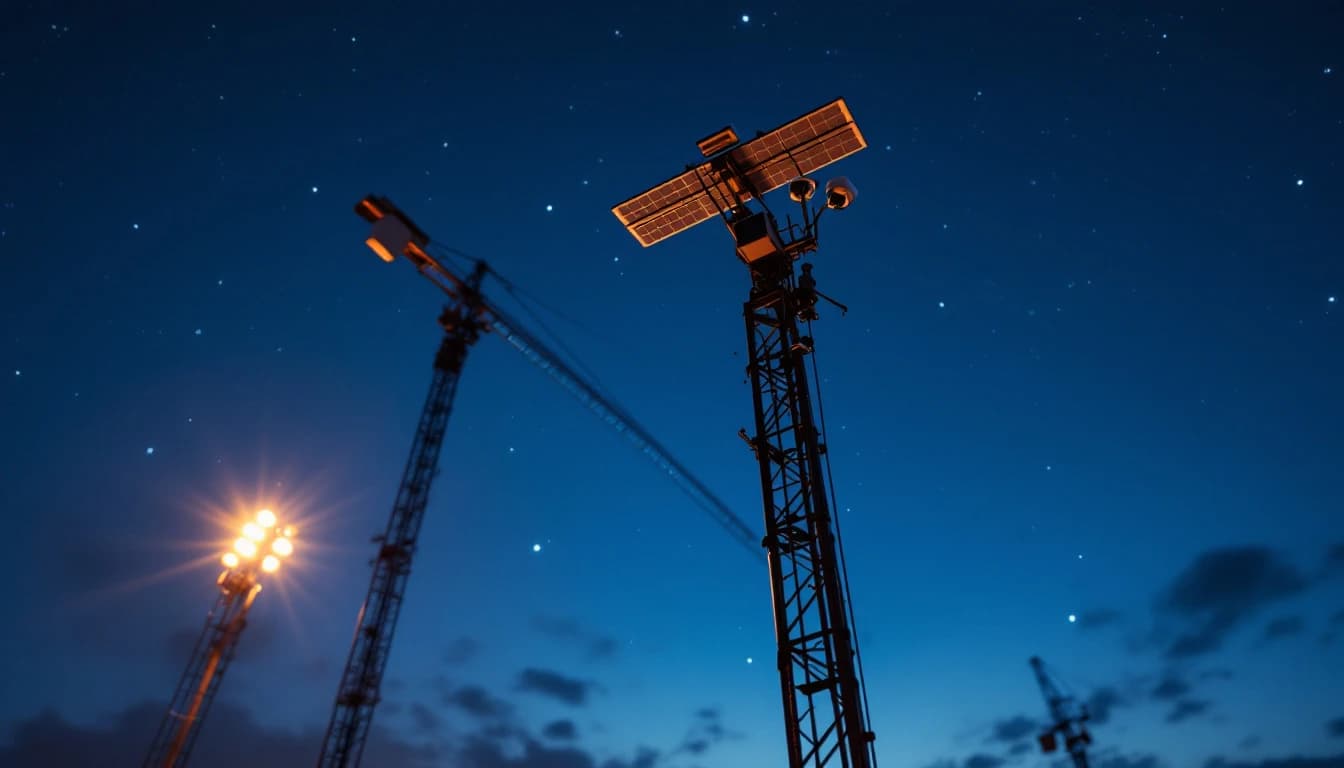
Direct answer: A construction security trailer is a self-contained security system: solar panels and batteries power a mast of cameras, an on-board computer runs AI detection on the video in real time, footage records locally, and LTE or satellite pushes alerts and live view to your phone — with sirens, strobes and talk-down audio deterring on site. No site power, internet or wiring is involved.
Layer 1: power
Everything starts with the energy budget. Solar panels (roughly 800–1,200W on a full-size SiteFortress 360) charge a LiFePO4 battery bank sized to run the whole system through nights and cloudy stretches. LiFePO4 chemistry matters for Texas: it tolerates heat, cycles thousands of times, and holds capacity for years. Power telemetry streams continuously so falling reserve is an alert to the operator, never a surprise outage.
Layer 2: cameras and mast
Height is coverage. A telescoping mast puts cameras at 18–20 ft — above stacked materials and equipment, out of casual reach, with sight lines across the site. Four fixed PoE cameras arranged for 360° coverage are the standard package; premium units add a PTZ (pan-tilt-zoom) camera for zooming into activity while the fixed cameras keep their quadrants.
Layer 3: edge AI
The defining upgrade of the current generation is where the thinking happens: on the trailer. An edge computer with an AI accelerator classifies people and vehicles in the video stream in real time, inside zones you define — the gate, the laydown, the fuel tank — on schedules you set. That kills the two failure modes of older systems: motion alerts that cry wolf at every headlight, and cloud analysis that stops working when connectivity dips.
Layer 4: recording
Footage records locally to SSD/NVMe storage on the unit. Local-first recording means a connectivity outage never costs you evidence, and there are no per-camera cloud fees. Clips and snapshots for events sync out for alerts and review.
Layer 5: connectivity
LTE carries alerts, live view and management traffic; Starlink is the upgrade for remote sites or weak cellular. Because analysis and recording are local, connectivity is a delivery channel — not a dependency for the security function itself.
Layer 6: deterrence and response
Detection can trigger the on-board siren, warning strobe and talk-down speaker — immediately and automatically, or after human verification when a monitoring workflow is attached. The escalation chain (who is alerted, what gets said, when authorities are contacted) is configured per site.
Finally, the unit watches itself: GPS and geofencing, tamper detection, camera/network health, and automated recovery attempts when a component stops responding. A security system whose own failures go unnoticed is theater; telemetry is what makes it real.
What a deployment day actually looks like
The architecture above arrives on a single-axle trailer and goes from truck to working system in a morning. Placement follows the surveyed plan; the mast goes up to 18–20 feet; cameras get aimed against the agreed coverage map; detection zones and schedules are drawn on the actual scene; connectivity is verified; and the escalation chain is configured before the installer leaves. There is no trenching, no conduit, no site power tie-in, no IT ticket — which is precisely why the same unit can follow a project through phases or move to the next site when this one closes.
Frequently asked questions
Do security trailers need power from the site?
No — that is the defining feature. Solar panels in the 800–1,200W class keep a LiFePO4 battery bank charged, and the bank is sized to run the full system through nights and multi-day cloudy stretches. Power telemetry streams continuously, so falling reserve is an operator alert days in advance rather than a surprise outage. The site provides a parking spot with sun exposure; the unit provides everything else.
How tall is the camera mast and why does height matter?
The telescoping mast puts cameras at 18–20 feet. Height is coverage: above stacked materials and equipment, out of casual reach, with sight lines across the whole site instead of into the nearest obstruction. It is the difference between a camera that watches a site and one that watches the back of a conex box — and it is why placement planning treats the site’s future shape, not just its current one.
What happens to the footage if the cellular connection drops?
Nothing is lost. Recording is local-first — footage writes to solid-state storage on the unit, and AI detection runs on the unit’s own computer, so both continue through any connectivity outage. What pauses is delivery: live view and alert push resume when the connection does, and clips sync out afterward. That architecture is the opposite of cloud cameras, which go effectively blind the moment the internet does.
What is edge AI and why does it matter on a jobsite?
It means the detection intelligence runs on the trailer itself rather than in a distant data center. An on-board computer classifies people and vehicles in the video in real time, inside zones you define and on schedules you set. That kills the two classic failure modes: motion-pixel alerts that cry wolf at every headlight, and cloud analysis that stops working when connectivity dips. Classification in under a second, on site, regardless of signal.
Can the trailer actually respond to an intruder, or just record one?
Both. Confirmed detections can trigger the on-board siren, warning strobe and talk-down speaker — immediately and automatically, or after human verification when the monitoring workflow is attached. The escalation chain is configured per site: who gets alerted, what the speaker says, and when authorities are contacted. Deterrence at machine speed is usually what ends the visit; the recording exists for the rare one it does not.
Who notices if the unit itself has a problem?
The unit does, and then we do. GPS and geofencing, tamper detection, camera and network health checks and battery telemetry all stream to the operations layer, with automated recovery attempts when a component stops responding and a service dispatch when it does not. A security system whose own failures go unnoticed is theater — self-monitoring is what separates a working system from a decoy with a solar panel.