Best placement for a construction security trailer
August 13, 2026 · updated August 29, 2026 · SiteFortress360
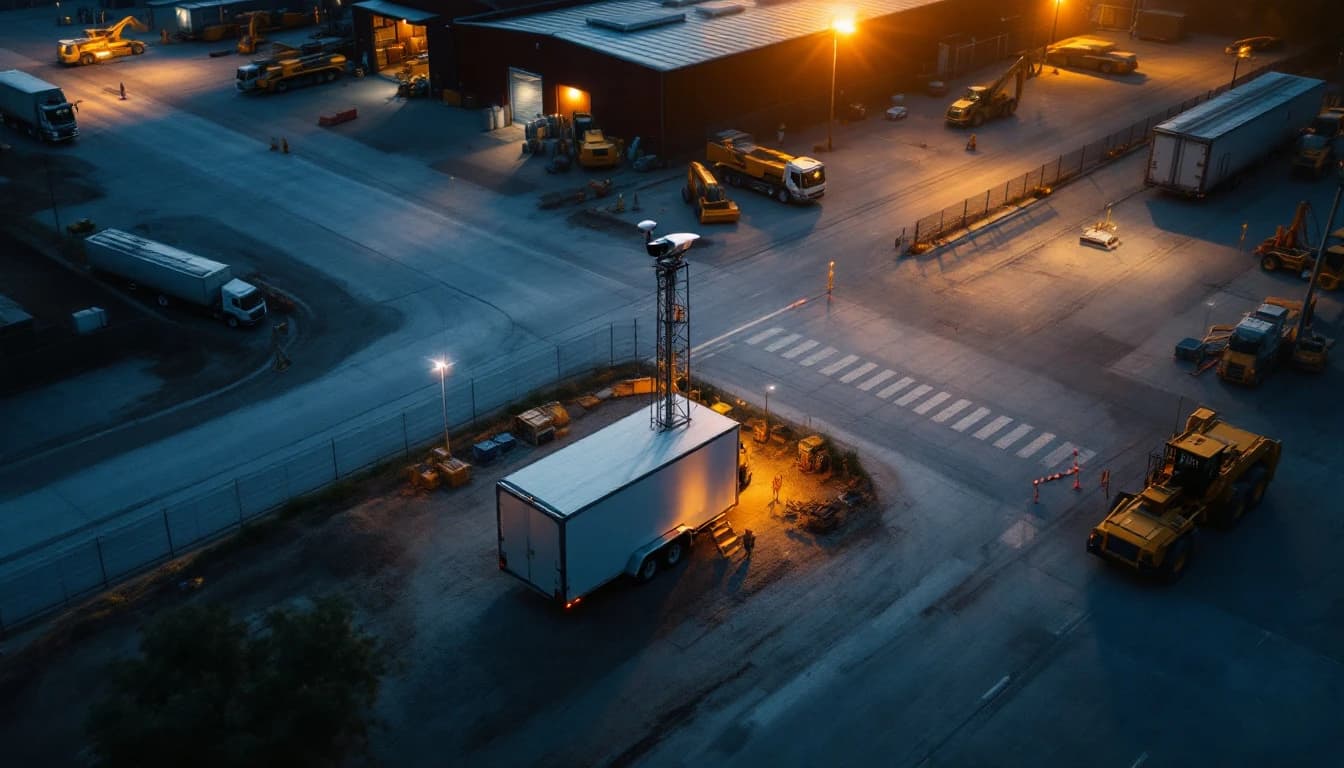
Direct answer: The best placement covers your highest-value zones and the main approach with unobstructed sight lines, gets good sun exposure for the solar array, and keeps the mast clear of overhead lines. On most sites that means a spot commanding the gate and laydown together — typically a front corner set back from the entrance, adjusted as stacked materials rise.
Cover value and approach together
Placement starts with two maps: where the value is (laydown, equipment rows, fuel, the trailer compound) and how vehicles approach (the gate, plus any informal back way). The unit should command as much of both as one placement allows. On typical rectangular sites, a front corner position watches the gate lane and the laydown diagonally across the site; dead-center placements look impressive but often waste half the coverage circle on empty ground.
Respect the physics
Three physical constraints rule placements. Sight lines: cameras cannot see through the concrete stack that will be there in month three — plan for the site’s future shape, and expect a mid-project reposition on vertical builds. Sun: the solar array wants open southern exposure; parking the unit in the shade canyon between two tilt-wall buildings starves it. Clearances: an 18–20 ft mast needs vertical room — walk the spot looking up before the trailer arrives, and stay well clear of overhead lines.
Common mistakes
The placements that generate regret:
- Hiding the unit “so it doesn’t get stolen” — concealment kills deterrence; the unit is tamper-monitored and GPS-tracked precisely so it can stand visible
- Facing cameras into the sunrise/sunset lane for the money shot of the gate — backlight ruins detection windows; angle across, not into, the sun line
- Parking against the fence where a box truck outside the line blocks two quadrants
- Forgetting the site’s future: steel up in month two erases the sight line the placement depended on
- Treating placement as final — repositioning is normal and included; the site changes, the unit should follow
We place it with you
Placement is part of every SiteFortress deployment: the survey walks candidate spots against value, approach, sun and clearances, and the agreed coverage is verified on camera before we leave — backed by the Deployment Promise. When the site evolves, we come move the unit and redraw the zones.
A note on power lines and mast safety
The clearance rule deserves its own paragraph because it is the one placement mistake with stakes beyond coverage. An 18–20 foot mast raised near overhead distribution lines is an electrical incident, not a security decision — utility clearance rules exist for exactly this class of equipment, and the survey treats any spot near overhead lines as disqualified rather than negotiable. Walk the candidate spot looking up before the trailer arrives; if there is any doubt about line height or lateral distance, the spot moves. No sight line is worth it.
Frequently asked questions
Who decides the final placement — us or you?
Together, on the survey walk, with the coverage map as the referee. You bring what we cannot know: where deliveries stage, which corner the subs cut through, what the site will look like in month three. We bring the sight-line, sun and clearance constraints and what has worked on comparable sites. The agreed map is then verified on camera at deployment under the Deployment Promise — if the agreed coverage cannot be verified, the deployment fee is waived — which keeps the conversation honest in both directions.
Does the trailer need a concrete pad or special ground preparation?
No pad, no preparation — a reasonably level, stable patch of ground the size of a parking space does it, and gravel, caliche or compacted dirt are all normal homes for a deployed unit. What matters more than the surface is the position: sight lines, sun exposure and mast clearance decide the placement, and the running gear handles ordinary jobsite ground. If the only candidate spots are mud bogs or steep grades, the survey flags it and we solve it together before delivery day.
Where is the best place to put a security trailer on a jobsite?
The spot that covers your highest-value zones and the main approach together, with clear sight lines, good southern sun exposure for the array, and vertical clearance for the mast. On typical rectangular sites that is a front corner set back from the entrance — commanding the gate lane and the laydown diagonally — rather than dead center, which often wastes half the coverage circle on empty ground.
Should the trailer be hidden so it does not get stolen?
No — concealment kills deterrence, which is most of what you are paying for. The unit stands visible on purpose: thieves scout, and a mast with a strobe changes the scout report. Theft of the unit itself is what the tamper monitoring, geofencing and GPS tracking are for. A hidden unit records crimes; a visible one prevents most of them from starting.
Does the placement need to change as construction progresses?
Usually, and planning for it beats fighting it. Cameras cannot see through the concrete stack that arrives in month three or the steel that goes vertical in month two, so vertical builds should expect a mid-project reposition. Repositioning is normal and included — the site changes shape, the unit follows, and the zones get redrawn to the new scene the same visit.
What about sun exposure — does direction really matter?
Twice over. The solar array wants open southern exposure, so the shade canyon between two tilt-walls starves the power budget. And the cameras want the sun behind or beside them, not in the lens: aiming into the sunrise or sunset lane for the perfect gate shot ruins detection during exactly the low-light windows that matter. Angle across the sun line, not into it.
How close can the mast be to power lines?
Treat overhead lines as a disqualifier, not a constraint to optimize. A raised mast near distribution lines is an electrical safety incident waiting on a gust of wind, and utility clearance rules exist for precisely this equipment class. The survey walks every candidate spot looking up; if line height or lateral distance is in doubt, the spot moves. Coverage is negotiable — clearance is not.