How do you stop cargo theft from a warehouse or truck yard?
October 10, 2026 · SiteFortress360
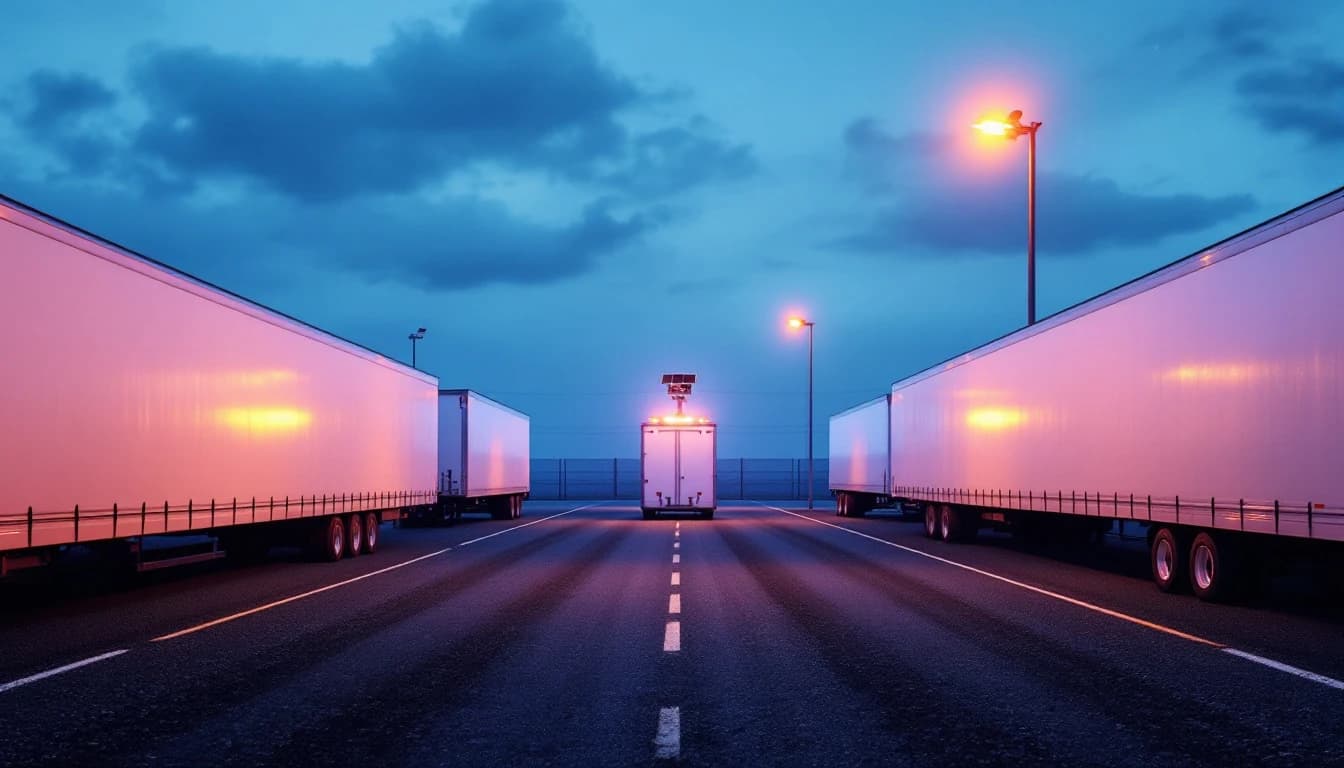
Direct answer: Treat the yard as the target, because that is where loaded trailers sit unattended. Work in layers: lock the trailer itself with kingpin and door hardware, control the gate and log every tractor that passes it, detect people and vehicles among the staged rows after hours, and make that detection loud at once. Cameras handle the last three. They do nothing against a fraudulent pickup with good paperwork, which is a process problem and needs a process answer.
The yard is the weak side of the building
Most warehouses are well protected where the product is stored and poorly protected where it waits. Inside there are dock cameras, an alarm panel, badge readers and people. Outside there is a gravel or concrete yard, a gate that is open for most of the working day, and a line of trailers that may each hold more value than a week of the building’s payroll.
A staged trailer is an unusual kind of asset. It is already loaded, already on wheels and already pointed at the exit. Nothing needs to be carried anywhere. That is why yard losses look different from building burglaries, and why the building’s security system, however good, tends to record the theft from a distance rather than interrupt it.
The Dallas–Fort Worth area concentrates this exposure. It is one of the largest freight and distribution regions in the country, with yards strung along the interstates and around the intermodal and airport corridors, and peak season adds overflow lots that have a fence and little else.
Four different thefts that get called cargo theft
The phrase covers at least four separate events, and they do not respond to the same countermeasure. Sorting your own history into these groups is the most useful hour you can spend before buying anything.
- Pilferage: doors opened on a staged trailer and part of the load removed, often discovered only at the receiver
- Hook-and-go: a tractor backs under a loaded trailer and leaves with all of it in a few minutes
- Fence-line entry: people on foot coming in from adjacent land, a rail spur or a drainage channel
- Fraudulent pickup: a driver with convincing paperwork is handed the load at the gate during business hours
Layer one: make the trailer itself hard to take
The cheapest layer is mechanical and belongs to the trailer, not the yard. A kingpin lock stops a tractor from coupling. A glad hand lock prevents the air lines from being connected, which keeps the trailer brakes applied. High-security door hardware and barrier seals slow down anyone trying to open the load.
None of these is expensive compared with a single loss, and none of them depends on power, signal or anyone being awake. Their weakness is discipline: a lock that is fitted to eight trailers out of ten protects eight trailers, and the crew walking the row will find the other two. Parking loaded trailers with their doors tight against a wall, a dock or another trailer costs nothing and removes pilferage as an option for those units.
Layer two: own the gate
Every hook-and-go theft passes through the gate, and so does every fraudulent pickup. If the yard can say with certainty which tractor took which trailer at what time, the difference to a recovery effort is enormous, because the first hours matter most and a plate turns a report into a search.
This is the job of a dedicated license plate recognition camera. It is a separate, lower-mounted camera aimed at the lane, because the angle and shutter settings that read a plate are not the ones that watch a yard. On our units LPR is a +$199 per month add-on, and it produces searchable plate events with timestamps, an entry and exit history, and alerts on vehicles you have not seen before.
Where the gate has a compatible operator, the gate control add-on at +$99 per month covers remote opening, schedules, authorized users and an access log. Compatibility and installation depend on the operator already fitted, so it is something to confirm on the site visit rather than assume.
Layer three: detect people among the rows, not just at the fence
Perimeter thinking fails in a trailer yard because the perimeter is long and the interesting part is small. What matters is a person on foot between staged trailers at two in the morning, or a tractor moving in the yard when the gate schedule says nothing should be.
That is what on-board detection is for. The unit’s AI classifies people and vehicles on the device, inside zones you draw and on schedules you set, so trailer rows can arm when the last shift ends while the fence line stays armed around the clock. Height is what makes it work in a yard: from an eighteen to twenty foot mast the cameras look down the aisles between trailers instead of at the side of the first one.
For long yards the usual recommendation is the SiteFortress PTZ Pro at $1,695 per month, which pairs four fixed cameras holding each quadrant with one PTZ that can zoom to inspect activity at distance. A smaller yard with a single fence line is generally well covered by the SiteFortress 360 at $995 per month.
Layer four: respond in seconds, not in the morning
A recording is evidence. It becomes prevention only if something happens while the crew is still in the yard. The first response is local and automatic: siren and warning strobe, and on the trailer units a talk-down speaker where it is configured. For a crew that expected an empty, dark yard, being lit up and addressed is frequently the end of the visit.
The second response is a person. With the 24/7 live monitoring add-on, from +$499 per month, a monitoring workflow verifies the event and follows the escalation plan you have agreed: voice-down, notification, and the escalation steps written into that plan. Without it, alerts with snapshots and clips come to your own phone, which works well if somebody is genuinely on call and poorly if the phone is on a nightstand in silent mode.
What a surveillance unit will not do for a yard
It is worth being exact here, because cargo security is a field where equipment gets oversold. A unit does not physically stop a tractor. If a crew is willing to be recorded and the trailer has no kingpin lock, the trailer can still leave, and what you have is a plate, a description and a timeline.
It does not track your trailers. The GPS on the unit reports the position of the unit. Tracking a load after it leaves is the job of telematics on the trailer or covert trackers in the freight, and for high-value lanes those belong in the plan.
And it does nothing about a fraudulent pickup. When a driver arrives in daylight with paperwork that matches the load and is waved through, every camera on site records a routine transaction. The defence is procedural: verifying the carrier and driver through a number you already hold rather than one printed on the paperwork, checking identification against the dispatch, and photographing the driver, tractor and trailer at release. A plate record helps afterwards. It does not replace the check.
Where a guard is still the right answer
A guard at the gate does things no camera does: reads a bill of lading, turns a truck around, notices that a driver is nervous. For a yard with heavy daytime traffic and high-value freight, a staffed gate during operating hours is a reasonable cost.
The overnight hours are where the arithmetic changes. One person in a booth cannot watch a long yard, and a lone guard should not be confronting a crew. A common arrangement is a guard on the gate while freight is moving and an autonomous unit, monitored or self-monitored, covering the rows after the last shift. Each is doing the part it is good at.
Overflow lots and outages
Two situations expose yards that are otherwise well run. The first is the temporary lot: a leased parcel down the road for peak season, with a fence, no power and no network. The second is a power outage at the main site, when building cameras and yard lighting go dark together.
A solar unit is suited to both because it never used site power or site internet in the first place. It runs on its own panels and battery bank, connects over LTE with Starlink available as an add-on for weak-signal locations, and records to local storage so an outage in connectivity does not create a gap in the footage. For a pop-up yard that exists for ten weeks, renting is also the only option that makes sense on paper.
A sequence that works
If you are starting from a yard with a fence and building cameras, the order matters more than the budget. Start with the measures that cost least and fail least, then add detection where the history says the losses are.
- Sort the last two years of incidents into pilferage, hook-and-go, fence-line and fraudulent pickup
- Fit kingpin and door hardware to every loaded trailer that stays overnight, without exceptions
- Park loaded trailers doors-to-wall wherever the yard layout allows it
- Tighten the release procedure at the gate before spending on equipment
- Add plate capture at the gate so every tractor movement has a record
- Put mast-height detection over the staged rows, armed to the shift schedule
- Decide who answers an alert at 2 AM, and add monitoring if the honest answer is nobody
Frequently asked questions
Our warehouse already has cameras and an alarm. Why would the yard need anything else?
Because building systems are designed around doors and docks, and yard theft often never touches either. A loaded trailer can be opened or coupled and removed without setting off anything inside. A mast-height unit over the staged rows detects people and vehicles in that space in real time and can sound a siren and strobe while they are still there.
Can a surveillance trailer stop someone from hooking up and driving off with a trailer?
Not physically. It can detect the tractor entering outside gate hours, trigger deterrence, alert you or a monitoring workflow, and record the plate if LPR is fitted. The thing that physically prevents coupling is a kingpin lock on the trailer. The two work together: the lock buys time, and the detection means that time is used.
Does the unit track stolen trailers or freight?
No. The GPS on a SiteFortress unit reports where the unit is, so that moving it raises an alert. It does not follow your trailers after they leave. Tracking a load in transit needs telematics on the trailer or a tracker in the freight, and for high-value lanes that should be part of the same plan.
What about fake drivers who show up with paperwork?
Cameras do not solve that, and anyone who says otherwise is selling. A fraudulent pickup looks like a normal release on video. The defence is procedural: confirm the carrier and driver through a contact you already hold, check identification against the dispatch, and photograph driver, tractor and trailer at release. Plate records are useful afterwards for investigators.
Which unit suits a distribution yard?
Long yards usually suit the SiteFortress PTZ Pro, because the PTZ camera can zoom to inspect activity at the far end while four fixed cameras keep continuous coverage of each quadrant. A compact yard with one fence line generally runs well on the SiteFortress 360. Very large yards may need two positions, which a site visit will show.
Can we rent a unit just for peak season overflow parking?
Yes, and that is one of the clearest cases for renting. An overflow lot with a fence and no power or network can be covered by a solar unit without any site infrastructure. The deployment and setup fee is waived with a six-month agreement, so for a shorter seasonal rental it is worth pricing both ways.