Light tower or surveillance trailer: which one protects a jobsite?
October 10, 2026 · SiteFortress360
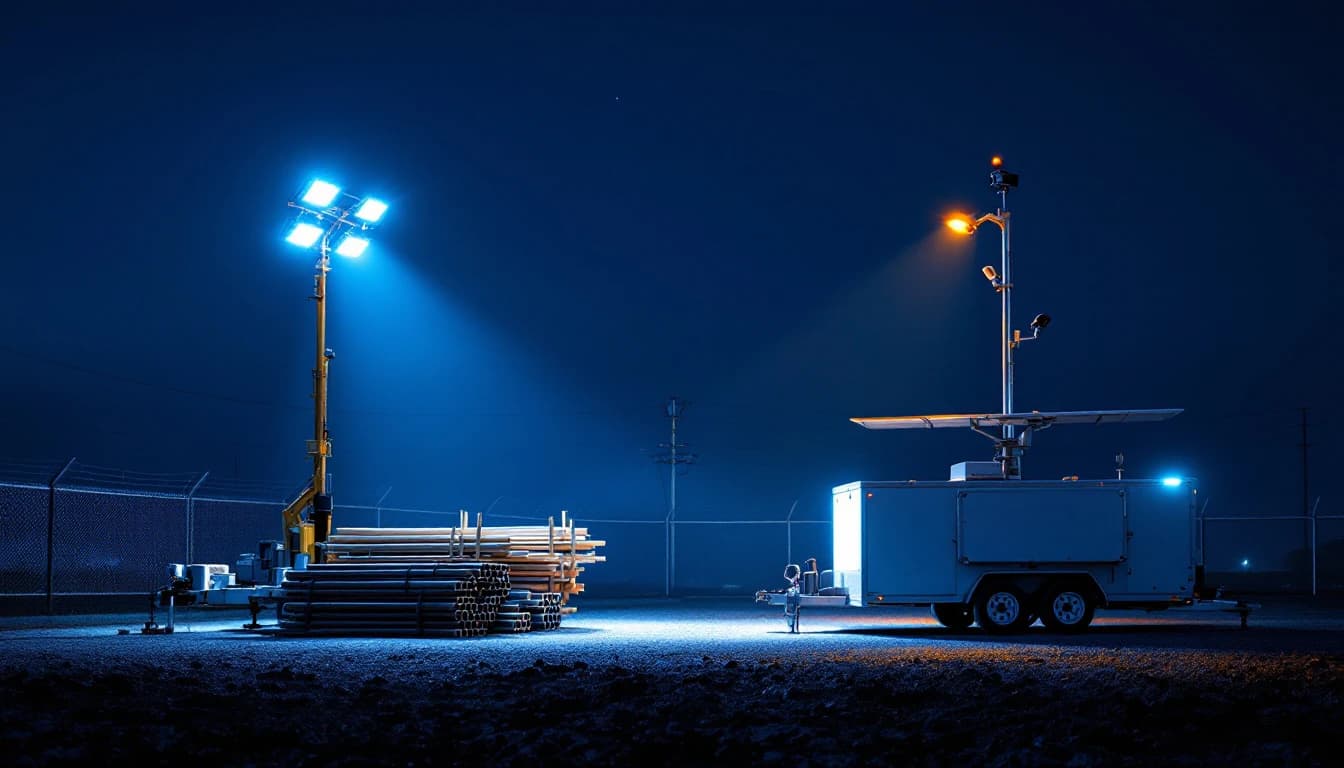
Direct answer: They solve different problems. A light tower lets people work and makes a site less comfortable to creep around, but it cannot notice anyone, tell anyone or record anything. A surveillance trailer detects people and vehicles, alerts you, records and sounds a siren and strobe, but it is not a work light. Lighting alone helps only where somebody is around to see what it reveals. For an unattended site overnight, detection matters more, and the best results come from using the light you already have to support the cameras.
Why the two get compared at all
On a rental quote they look like cousins. Both arrive on a trailer, both have a mast, both stand in the yard all night, and a superintendent with a theft problem and a light tower already on rent will reasonably ask whether simply leaving the lights on would do. Lighting is also the oldest security advice there is, and it is not wrong. It is incomplete.
The useful way to compare them is by function. Security needs four things to happen: a thief has to be discouraged, an intrusion has to be noticed, somebody has to be told, and there has to be a record afterwards. Go through those four and the difference is plain.
What a light tower actually does
A light tower exists so that people can work safely in the dark. OSHA’s construction illumination standard sets minimum lighting levels for work areas, starting at five foot-candles for general construction areas, and a night pour, a road closure or winter hours on an open site cannot be done without it. Nothing on a camera mast replaces that.
As security, light does one thing well: it removes concealment. A person standing in a pool of white light can be seen from the road, by a passing patrol, by a neighbor or by a camera. That raises the risk a thief feels, which is deterrence of a real kind.
The limit is that light is passive. It does not know anyone is there. Research on lighting and crime, including work catalogued by the National Institute of Justice, generally finds that improved lighting helps most where it increases the chance of somebody seeing and reacting. On a fenced site at the end of an industrial road at 2 AM, there may be no such somebody. In that setting a well-lit yard can simply be a yard where the thief can see what they are doing.
What a surveillance trailer actually does
A surveillance unit covers the three functions lighting leaves out. On-board AI detects people and vehicles in the zones and hours you set. An alert with a snapshot and clip leaves the site over LTE. Video is written to local storage on the unit, so it exists whether or not the connection held. And detection can fire a siren and warning strobe, with talk-down audio on the trailer units where configured.
What it does not do is light the work. A warning strobe is a signal, not illumination, and nobody should plan a night shift around a security mast. If the job needs light to work by, it needs a light tower regardless of what is watching the fence.
Side by side, function by function
Set against the four things security has to achieve, the two machines barely overlap.
- Discourage: both, in different ways. Light removes hiding places; a strobe, siren and voice respond to a specific person
- Notice: only the surveillance unit. A light tower has no way of knowing the site has been entered
- Tell someone: only the surveillance unit, by alert to your phone or to a monitoring workflow
- Leave a record: only the surveillance unit, on local storage
- Let crews work at night: only the light tower
The running cost nobody puts on the quote
Most light towers on jobsites are diesel. Running one from dusk to dawn as a security measure means burning fuel every night, sending someone to refuel it, servicing the engine on hours, and living with the noise, which matters on a site with houses nearby. A tower that runs out of fuel at 1 AM protects nothing for the rest of the night, and nobody finds out until morning. Diesel in a tank on an unattended site is also something people steal.
Solar and battery light towers remove most of that and are worth asking your rental yard about. They do not change the basic point, which is that a light of any kind cannot report an intruder.
A SiteFortress unit runs on its own solar panels and LiFePO4 battery bank, with no generator, no fuel and no nightly visit. Pricing is published: the SiteFortress Mini is $695 per month, the SiteFortress 360 is $995 and the PTZ Pro is $1,695, with a deployment and setup fee that is waived on a six-month agreement. Get the light tower figure from your rental yard for the same months, then add the fuel and the labor to refuel it before comparing.
Where lighting wins
There are situations in which a light tower is the better spend, and it is worth saying so plainly.
- Any night work, because illumination for the task is a safety requirement and not a security choice
- A site that is occupied around the clock, where people are present to see what the light shows
- A frontage on a busy street or facing occupied buildings, where passers-by are a real audience
- A short exposure of a few nights, when there is a tower on site already and nothing of great value staged
- Entrances and walkways where crews and delivery drivers need to see their footing
Where lighting is not enough
The pattern that defeats lighting is the unattended site with no natural witnesses: greenfield subdivisions, industrial parks after hours, a laydown yard behind the building, a site at the edge of the Metroplex where the nearest neighbor is a field. On those sites the theft takes ten minutes, the light makes it easier, and the loss is discovered at 6:30 the next morning with no idea when it happened or who did it.
It is also not enough whenever you need to prove something afterwards. A police report, an insurance claim and a conversation with a subcontractor about missing material all go better with a time, a vehicle and a clip. Light produces none of those.
Using both: light that helps the cameras
On many jobs the answer is both, and they are better together than apart if they are placed with each other in mind. Cameras produce their most useful footage, with color and detail on clothing and vehicles, when the scene is lit. A light tower aimed across the material stack or the equipment line from behind the camera position improves every clip from that direction.
The mistake to avoid is pointing light at the cameras. A tower that shines into a lens turns a person walking in front of it into a black outline, which is the opposite of the intention. The same goes for headlights at a gate: the plate camera on an LPR setup is a separate camera partly because glare has to be managed at that spot.
Dark corners matter as well. A site that is brilliant in the middle and black along the back fence has told an intruder where to walk. Either light the approach or make sure it is inside an armed detection zone. The cameras work in low light and darkness without any site lighting, so the unlit side is covered, but only if a zone has been drawn over it.
- Put the light behind or beside the camera position, shining the way the cameras look
- Never aim a tower toward the mast
- Light the things worth stealing, not the empty middle of the lot
- Draw detection zones over whatever stays dark
- Ask at the placement survey how existing lighting should be worked around
A quick way to decide
Ask two questions. Is anyone working on this site after dark? If yes, you need lighting, whatever else you do. Is the site ever left with nobody on it and something worth taking? If yes, you need something that can notice and report, and a light cannot. Plenty of sites answer yes to both, and for them the budget conversation is about which light tower nights can be dropped once the unit is watching, not about choosing one machine over the other.
Frequently asked questions
Does leaving the lights on overnight prevent jobsite theft?
It helps where somebody can see the site, such as a busy road frontage or a site next to occupied buildings. On an isolated or fenced site with no witnesses, lighting on its own does little, because nothing detects the intruder and nobody is told. Light supports security. It is not a security system.
Can a surveillance trailer replace my light tower?
Not for working light. A SiteFortress unit carries cameras, a siren and a warning strobe, and the strobe is a signal rather than illumination. If crews work after dark you still need lighting that meets OSHA’s minimum levels for the task. What the unit can replace is the light tower that was being left running purely as a deterrent.
Do the cameras need site lighting to see at night?
No. The cameras operate in low light and darkness and the on-board AI classifies people and vehicles at night as it does by day, so an unlit site is still covered. Good lighting does improve the detail in recorded footage, particularly color on clothing and vehicles, which is why the two work well together.
Is a light tower cheaper than a surveillance unit?
The rental line often is, so compare the whole cost. A diesel tower run all night adds fuel, refueling labor and engine servicing every month, and it can run dry unnoticed. Our pricing is published, starting at $695 per month for the SiteFortress Mini with no fuel or generator. Ask your rental yard for a like-for-like figure.
Where should a light tower go if I also have cameras?
Behind or beside the camera position, shining in the direction the cameras look, and aimed at the material and equipment rather than the open ground. Never point it toward the mast, because glare turns a person into a silhouette. Whatever part of the site stays dark should sit inside an armed detection zone.
Are solar light towers a good alternative?
For lighting, often yes. They avoid the fuel, noise and refueling visits of a diesel unit, and they are worth pricing with your rental yard. They are still lights. A solar light tower cannot detect a person, send an alert or record an incident, so it does not close the gap that a surveillance unit fills.