How much should you budget for jobsite security over the whole project?
October 2, 2026 · SiteFortress360
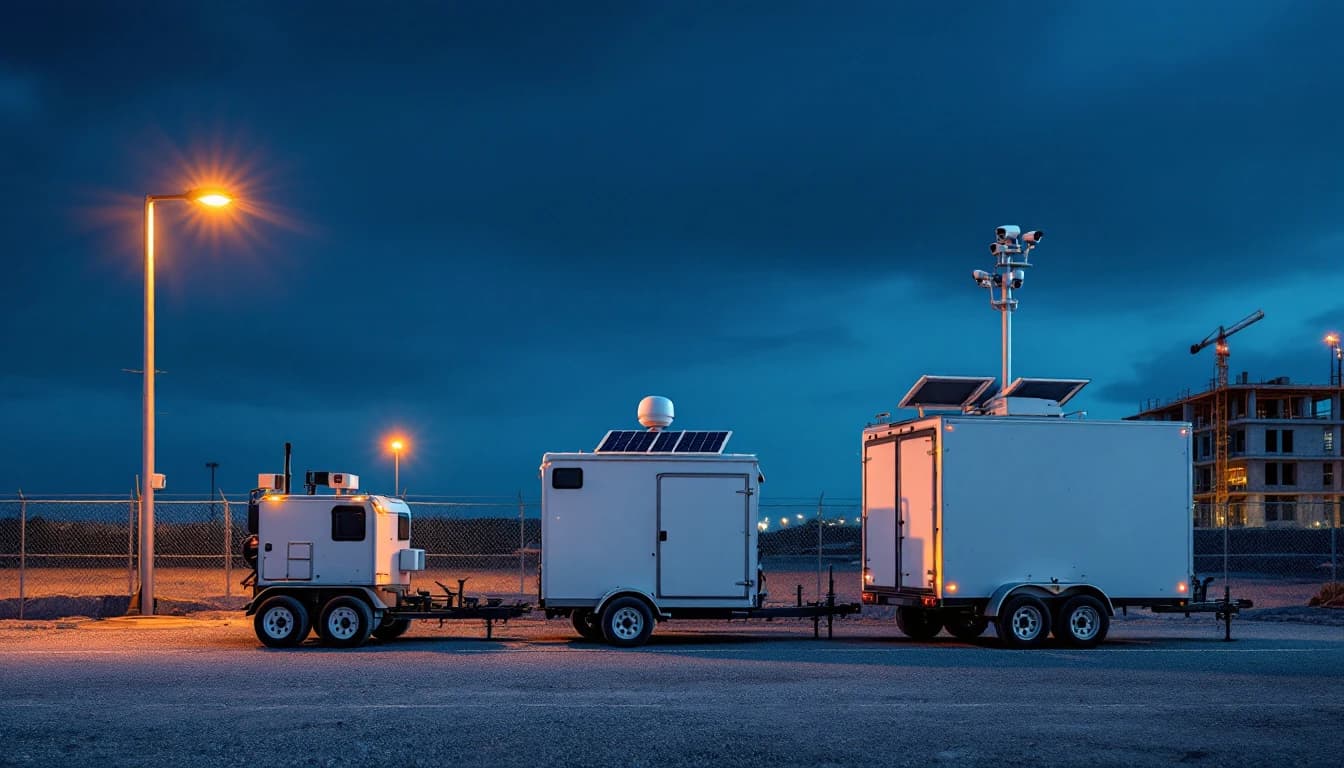
Direct answer: Price the project, not the month. On published SiteFortress360 rates, a typical 6-month job totals $4,170 with a Mini, $5,970 with a SiteFortress 360 and $10,170 with a PTZ Pro, because the deployment fee is waived on a 6-month agreement. Shorter month-to-month jobs add a one-time $299 to $699 setup fee. Add-ons are flat monthly amounts, so the whole-project number is multiplication you can do before you call anyone.
Why the monthly rate is the wrong unit
Nobody budgets a building by the month. The estimate carries a number for the whole job, security sits inside general conditions alongside temporary fencing and the site office, and the question a project manager actually has to answer is what figure goes on that line. A monthly rate does not answer it until you have multiplied by a duration, added whatever is charged once, and added whatever is charged on top.
With most security vendors that arithmetic is impossible to do in advance, because the rate only appears after a call and the extras appear after the contract. It is possible here because every input is published. This guide does the multiplication for the common project lengths so you can drop a figure into an estimate, and it is explicit about the two places the answer changes: the one-time deployment fee, and the add-ons.
The three inputs on every unit
There are only three numbers. The monthly rate depends on the unit: $695 for the SiteFortress Mini, $995 for the SiteFortress 360 and $1,695 for the PTZ Pro. The one-time deployment and setup fee is $299, $499 and $699 respectively, and it is waived entirely on a 6-month agreement. Add-ons, if you want them, are flat monthly amounts that do not change with the unit.
Month-to-month rental is available on all three. That matters for the short jobs below, because it means the choice is never between committing to six months and having nothing. The choice is between paying a setup fee for flexibility and waiving it for a commitment.
- SiteFortress Mini — $695 per month, $299 setup
- SiteFortress 360 — $995 per month, $499 setup
- SiteFortress PTZ Pro — $1,695 per month, $699 setup
- Setup fee waived on a 6-month agreement; month-to-month also available
A short job: two to five months
Short deployments are things like a re-roof, a tenant demolition, a retail pad, a vacant building waiting on a sale, or a few weeks of cover after a break-in. These run month-to-month, so the setup fee is paid. For a typical two-month job the totals are $1,689 with a Mini, $2,489 with a SiteFortress 360 and $4,089 with a PTZ Pro.
The thing to notice is how much of a short job the setup fee represents. Spread over only two invoices, it adds between a fifth and a quarter to the effective monthly cost. That is not a hidden charge — it pays for delivery, placement, camera positioning, detection-zone configuration and onboarding, which is the same amount of work whether the unit stays eight weeks or eighteen months — but it is the reason a very short rental looks more expensive per month than the headline rate.
The interesting case is the job that might run five months. Five months month-to-month on a SiteFortress 360 is five payments plus the setup fee; a 6-month agreement is six payments and no fee. The gap between those two totals is less than half of one monthly payment on the 360, and a little over half on the Mini and the PTZ Pro. Put plainly, the sixth month costs roughly half its sticker price. Since construction schedules slip far more often than they shorten, a job estimated at five months is usually better placed on the 6-month agreement. A job that is genuinely four months or less is cheaper month-to-month.
One caution: read what the agreement says about ending early before you commit on a job that could finish ahead of schedule. The signed rental agreement is the controlling document, and the right time to ask that question is before signing rather than at closeout.
The standard job: six to twelve months
This is where most commercial and multifamily work lands, and it is the simplest arithmetic, because the setup fee is gone and the total is the monthly rate times the months. For a typical six-month job that is $4,170 with a Mini, $5,970 with a SiteFortress 360 and $10,170 with a PTZ Pro.
For a typical ten-month job the totals are $6,950, $9,950 and $16,950. For a full twelve months they are $8,340, $11,940 and $20,340. Applicable taxes may be added to any of these, so treat them as the pre-tax line.
If you are choosing between units, the project view makes the trade clearer than the monthly view does. Over ten months, stepping up from a Mini to a SiteFortress 360 costs three thousand dollars for a mast that is roughly eight feet taller and a trailer platform with a larger power system. Stepping from the 360 to the PTZ Pro costs seven thousand dollars for a camera that can zoom in on what the fixed cameras detect. Whether either step is worth it depends on the size of the site and what is on it, and it is a much easier judgment when it is expressed as one figure against the value being protected.
The long job: fourteen months and beyond
Long projects are multiplication again: for a typical fourteen-month build, $9,730 with a Mini, $13,930 with a SiteFortress 360 and $23,730 with a PTZ Pro. At eighteen months those become $12,510, $17,910 and $30,510.
Two honest points apply once a job gets this long. The first is that the security need does not stay constant across eighteen months. The open-site phases — mobilization, structure and rough-in — are when an exterior unit earns the most. Once the building is enclosed and powered, some of the risk moves indoors where a mast camera cannot follow it, and fixed interior cameras on house power start to be the better tool. It is worth asking at the outset how the configuration can change as the project moves through its phases rather than assuming month sixteen needs what month three needed.
The second is that at long durations people reasonably ask whether they should simply buy a trailer. Sometimes they should: a contractor with continuous back-to-back work and somebody on staff to tow, aim, maintain and monitor a unit can come out ahead on ownership. Most cannot, because the purchase price is only the first cost. We have set out that comparison separately and it is worth reading before signing anything long.
What the add-ons add
Add-ons are flat monthly amounts, so over a project they are also simple multiplication. License Plate Recognition is $199 per month, Starlink connectivity is $100, Gate Control is $99, Drone Awareness is $99, and 24/7 Live Monitoring starts from $499.
On a ten-month job that means plate recognition adds a little under two thousand dollars, Starlink adds one thousand, gate control or drone awareness adds a little under one thousand each, and monitoring adds from about five thousand. Monitoring is the one that moves the total, and it is also the one most worth thinking about by phase rather than by project: the argument for a human verifying every detection overnight is strongest during the weeks when the most portable value is on site. Ask whether an add-on can be switched on for the months that need it rather than assuming it has to run for the whole term.
The practical rule is to budget the unit for the whole exposure and budget the add-ons against a specific problem. A gate with real vehicle traffic justifies plate recognition. A site at the edge of cellular coverage justifies Starlink. A site with an active theft problem justifies monitoring. An add-on bought because it was on the list is the easiest money on the estimate to give back.
- License Plate Recognition — $199 per month
- Starlink connectivity — $100 per month
- Gate Control — $99 per month
- Drone Awareness (Remote ID) — $99 per month
- 24/7 Live Monitoring — from $499 per month
What to put next to the number
A security line is easier to defend when it sits beside the two figures it competes with. The first is the alternative. One overnight guard post at prevailing DFW rates runs well north of $6,000 per month, so the same ten months of overnight guard coverage costs more than sixty thousand dollars — several times the ten-month PTZ Pro total, for one person watching one direction.
The second is the contract itself. On a three-million-dollar build, ten months of a SiteFortress 360 is roughly a third of one percent of the contract value. Expressed that way it stops being a discretionary extra and starts looking like what it is, which is a small fixed cost against an unbounded one.
The unbounded one is the loss. We deliberately do not quote a theft statistic here, because the honest number is yours: your deductible, the count of losses you absorbed last year without filing anything, and the schedule cost of the worst one. Most contractors who write those three figures down find the security line is smaller than the second of them.
What this budget does not include
A project total built from published rates is accurate and still incomplete, and it is better to hear that from us. Applicable taxes may apply. The equipment remains ours and the customer is responsible for loss or damage beyond normal wear under the agreement, so it is worth a call to your broker about how rented equipment on site is treated, the same way you would for a rented excavator.
The figure also covers the system, not the response. On the base configuration an alert goes to your phone, and the plan works only if somebody is designated to look at it. If nobody will, that is what the monitoring add-on is for, and it belongs in the budget from the start rather than after the first incident. Finally, any guard hours you keep for daytime access control are their own line. A unit replaces the overnight watching, not the person checking delivery tickets at the gate.
Frequently asked questions
How much does jobsite security cost for a 6-month project?
On published SiteFortress360 rates, a typical six-month job totals $4,170 with the Mini, $5,970 with the SiteFortress 360 and $10,170 with the PTZ Pro, before any applicable taxes. The one-time deployment fee is waived on a 6-month agreement, so the total is simply the monthly rate multiplied by six. Add-ons such as plate recognition or monitoring are added as flat monthly amounts.
Is month-to-month or a 6-month agreement cheaper for a five-month job?
The 6-month agreement is usually the better choice, because the waived setup fee means the sixth month costs roughly half its normal price, and schedules slip more often than they shorten. For a job that is genuinely four months or less, month-to-month with the setup fee is cheaper. Check what the agreement says about ending early before you commit either way.
What does a full year of a surveillance trailer cost?
Twelve months at published rates comes to $8,340 for the Mini, $11,940 for the SiteFortress 360 and $20,340 for the PTZ Pro, with no deployment fee because the term exceeds six months. For comparison, a typical overnight guard post in Dallas–Fort Worth costs well over $6,000 in a single month, so a full year of the mid-range trailer costs about what two months of that guard would.
How do add-ons change the project total?
Each one is a flat monthly amount multiplied by the months you run it: $199 for License Plate Recognition, $100 for Starlink, $99 each for Gate Control and Drone Awareness, and from $499 for 24/7 Live Monitoring. Monitoring is the only one that materially moves a project total, so match it to the phases with the most portable value on site.
Where does site security go in a construction estimate?
It normally sits in general conditions with the other temporary site costs such as fencing, the site office and temporary utilities. Carrying it as a whole-project figure rather than a monthly rate makes it easier to defend, because it can be shown beside the contract value and beside the cost of the guard coverage it replaces.
Does the budget change if the project runs long?
Only by the extra months. There is no second setup fee for staying longer, so an overrun costs the published monthly rate for each additional month and nothing else. That makes a slipped schedule easy to price: multiply the rate by the months of delay. It is still worth confirming how the agreement continues after its initial term before you sign, so the answer is in writing.