Should you rent or buy a mobile security trailer?
August 30, 2026 · SiteFortress360
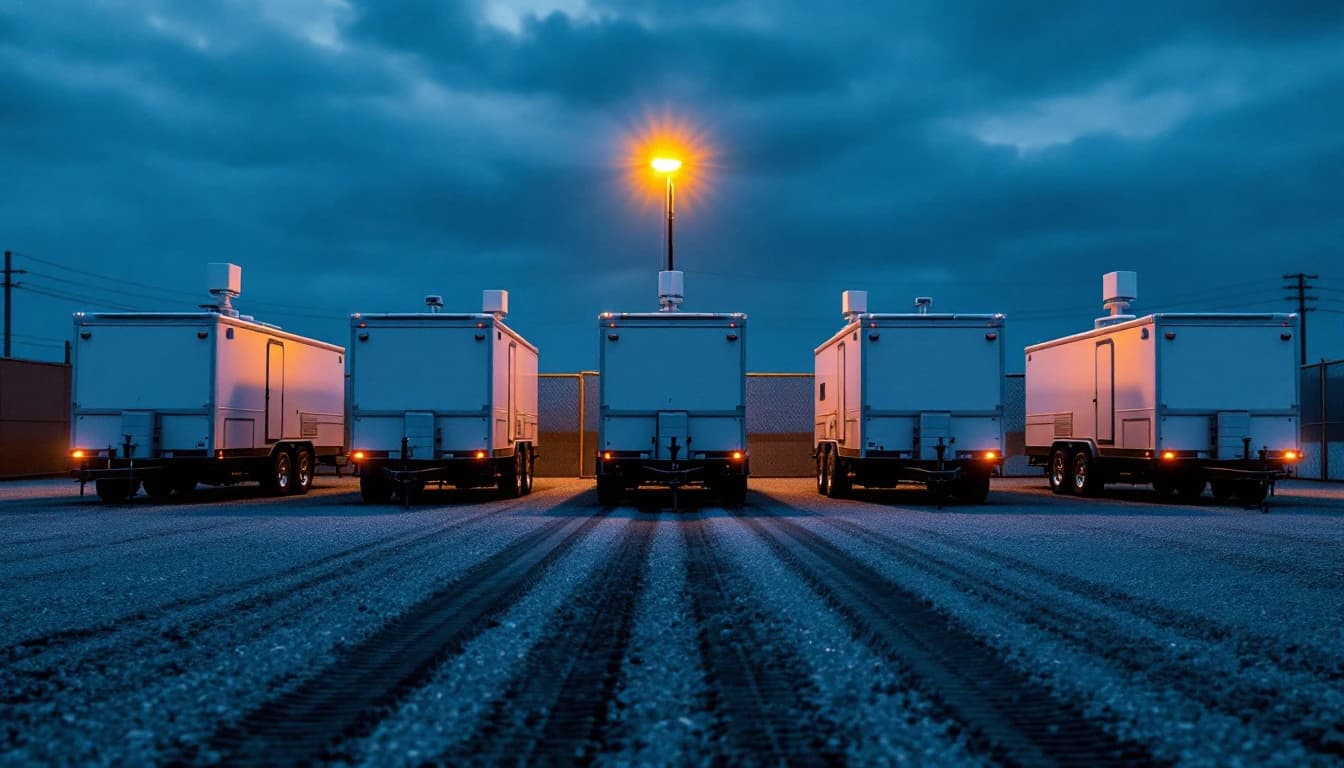
Direct answer: Rent when the need moves, changes or ends — which describes almost every construction, yard and vacancy deployment. Buying only wins when one fixed location will run a unit continuously for years and you already employ people who can service solar, batteries, cameras and cellular hardware at 2 AM. The purchase price is the smallest part of ownership: connectivity, maintenance, storage between deployments, battery replacement and obsolescence all move onto your books the day you buy.
What the purchase price does not include
A surveillance trailer is not a piece of equipment you park and forget. It is a small off-grid power plant with a computer, a cellular modem and a road-legal chassis bolted to it, and the purchase price buys the first day of that. Everything after day one is yours: the cellular data plan on every unit, the battery bank that will not hold its original capacity forever, the solar array that degrades on a measurable curve, the trailer registration and tires and lights, the insurance line, and the yard space the unit occupies for every month it is not on a job.
None of that is exotic or hidden. It is simply the difference between a capital number that appears once in a budget meeting and an operating number that appears every month afterwards — which is why owned fleets so often look cheap on the spreadsheet that justified them and expensive in the third year.
- Cellular data on every unit, every month it is deployed
- Battery bank replacement on a service interval, not at failure
- Solar array cleaning, plus measurable annual output degradation
- Camera, mast, seal and enclosure maintenance after Texas heat and hail
- Trailer registration, tires, lights and roadworthiness
- Insurance on the hardware, wherever it happens to be parked
- Secure storage between deployments — an idle unit in a yard is itself a target
- Labor to deploy, level, aim, configure, retrieve and clean each rotation
Utilization is the whole argument
Rent versus buy is not really a price question. It is a utilization question, and it has a clean form: what does a protected night actually cost you? A rented unit costs nothing on the nights you do not need it, because the rental ends when the project does. An owned unit costs the same in December parked behind your shop as it did in July over an active pad.
Run your own history before you run anyone else’s pricing. Count the months in the last three years when you genuinely had a site that needed autonomous coverage. If that number is close to thirty-six, ownership deserves a serious look. If it is closer to twelve or eighteen — the normal answer for a contractor whose projects start and finish — you would be buying three years of cost to get a year and a half of protection.
Term length runs on the same logic, which is why our own pricing reflects it: the one-time deployment fee of $299 to $699 is waived entirely on a six-month agreement, because a six-month deployment is one mobilization instead of two.
Who fixes it at two in the morning
The failure modes on an autonomous unit are unglamorous and they do not wait for business hours. A camera drops off the switch. A modem wedges. A long overcast stretch pulls the battery bank down far enough that the system starts shedding load. A tilt sensor fires because somebody clipped the tongue with a skid steer while backing up.
On a rented unit that is the vendor’s problem and the vendor’s telemetry. Every SiteFortress unit reports power, solar and battery health continuously, runs an automated device watchdog and supports remote camera and network reboot precisely so most of those events resolve without anyone driving anywhere. On an owned unit, the watchdog is a person on your payroll and the truck roll is yours.
This is the cost that never appears in a purchase comparison and always appears in the second year of owning one: the quiet expectation that somebody in your organisation now knows how a lithium iron phosphate bank behaves in February and what a power-over-ethernet budget is.
The obsolescence problem is specific to AI
The trailer is steel and it will outlive everyone reading this. What dates is the detection. The practical difference between a system that alerts on a person walking the fence line and one that alerts on every set of headlights, every plastic bag and every stray dog is entirely a software and edge-compute question — and that is the part of the machine improving fastest.
When you buy, you buy the detection quality of the year you bought in, and improving it means touching hardware you now own. When you rent, fleet refresh is the vendor’s incentive rather than your capital request. How much that matters depends on how much of the value you are buying is deterrence — which is steel, light and sound, and ages slowly — versus verification, which is software, and does not.
When buying genuinely wins
There is a real case for ownership and it is worth naming plainly, because a vendor who cannot describe the conditions under which you should not rent from them is not giving you information.
- One location, continuously, for multiple years — a plant, a permanent yard, a fixed lot
- In-house electricians or IT staff who already maintain field equipment
- A capital budget that prefers depreciation to an operating line
- No relocation requirement, so nobody has to tow, level, re-aim and reconfigure
- Enough units that a spare can absorb one being down
The uncomfortable follow-up to that list
Notice what those conditions describe: a fixed site. And at a genuinely fixed site with utility power available, a permanently mounted camera system on poles usually beats a trailer on both cost and coverage. The trailer’s entire advantage is that it moves and needs nothing from the property — no power, no internet, no trenching, nothing to un-build at closeout.
So if the honest answer to “will this ever move?” is no, the real comparison is not rent versus buy at all. It is temporary versus permanent infrastructure, and that is a different question with a different answer.
A five-minute decision rule
Answer five questions and the choice usually makes itself. How many months in the next thirty-six will you actually have a site that needs coverage? Will the unit move between sites, or between positions on one site? Who on your team diagnoses it when it stops reporting? Does your budget prefer a capital line or an operating one? And if it fails on the worst possible night, whose name is on the fix?
For most construction, yard and vacancy work in Dallas–Fort Worth the answers point the same direction, which is why the rental model exists at all. Published rates make the comparison easy to run: $695 per month for the Mini portable tower, $995 for the SiteFortress 360 trailer and $1,695 for the PTZ Pro, with connectivity, local recording, health telemetry and maintenance already inside the number.
Frequently asked questions
Is it cheaper to buy a security trailer than to rent one?
Only at high utilization. Ownership converts a monthly number into a capital number plus an operating tail: connectivity, batteries, panel degradation, insurance, storage, registration and the labor to deploy and retrieve. If a single site will run a unit continuously for several years and you already employ people who service field equipment, buying can win. For project-length work that starts and finishes, renting is usually cheaper per protected night and always cheaper in attention.
How long does a purchased unit take to break even?
Do the arithmetic against protected nights rather than calendar months, because that is where owned fleets lose. Take the purchase price plus a realistic annual operating figure for connectivity, maintenance, batteries, insurance and storage, then divide by the months the unit will genuinely be deployed and earning its keep. Compare that to $995 per month. The result swings enormously on utilization and barely at all on the sticker price.
What maintenance does a solar surveillance trailer actually need?
Panel cleaning, because dust and pollen on a Texas array cost real output. Battery inspection and eventual replacement on a service interval rather than at failure. Seal, enclosure and mast checks after hail and heat. Camera cleaning and re-aiming after every move. Connectivity and firmware attention. And the trailer itself — tires, lights, bearings, registration. On a rental all of that is included and scheduled. Owned, it is a calendar somebody has to keep.
Can I rent month to month instead of committing to a term?
Yes. Month-to-month is available on every unit and it is the right call for incident response, a short vacancy or a project with an uncertain end date. The trade is the one-time deployment fee of $299 to $699 depending on unit, which the six-month agreement waives entirely. Most construction and yard deployments clear six months without trying, so the waiver is usually free money rather than a lock-in.
What happens if I buy a unit and then the site moves?
You tow it, level it, re-aim every camera, redraw the detection zones and re-verify coverage — which is exactly the work the deployment fee pays for on a rental, done by people who do it weekly. Relocation is not hard. It is simply work that has to be done correctly, because a trailer that moved and was never re-aimed is a trailer carefully watching the wrong ground.
Who insures the hardware on a rental?
Ask your carrier and your vendor directly, and get the answer written into the agreement rather than left in a conversation. It belongs on the short list of questions worth asking any provider before signing, alongside whether connectivity is included, where recording lives during an outage, whether detection is genuine person and vehicle classification, and what early termination costs.