How do you secure a vacant commercial property?
August 29, 2026 · SiteFortress360
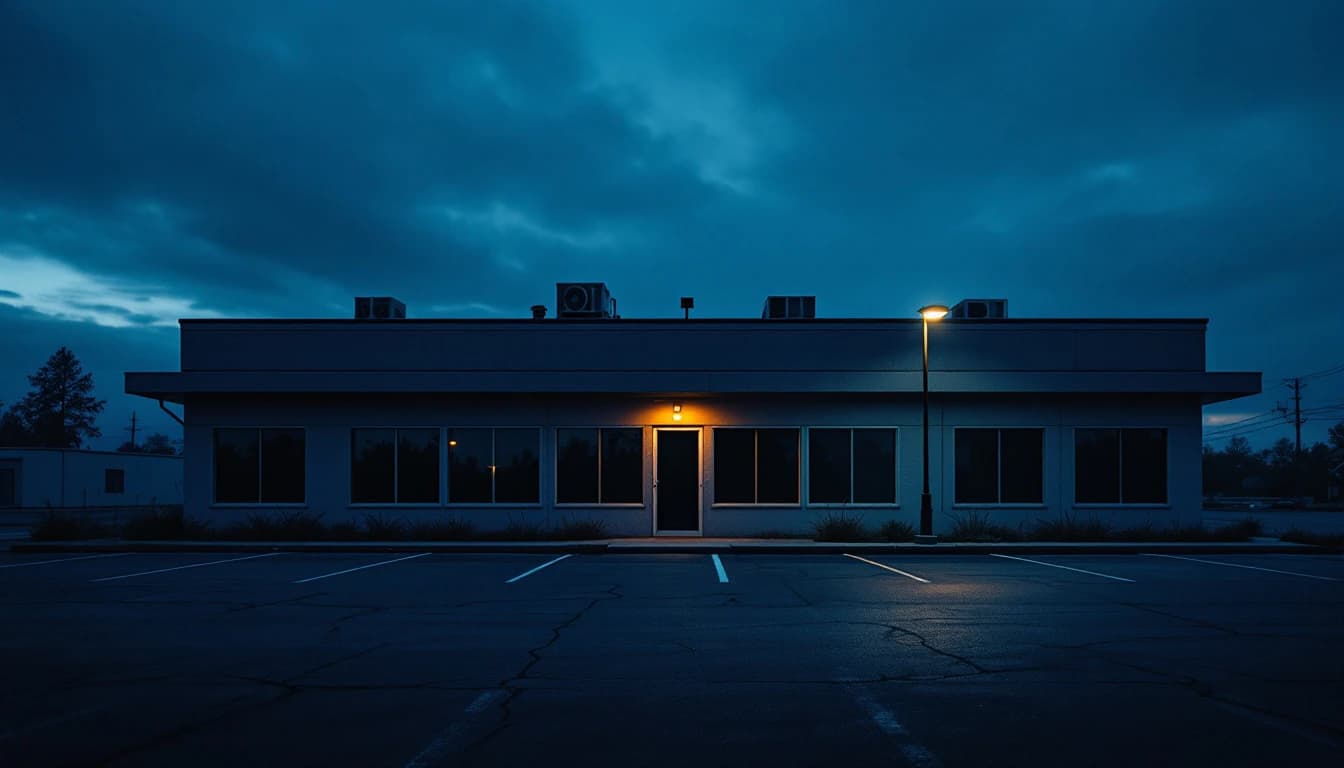
Direct answer: Secure a vacant commercial building in the order intruders actually work it: the lot first, then the roof, then ground-floor openings, then the interior. Most losses at empty properties are exterior — rooftop HVAC copper, catalytic converters, and anything a vehicle can reach — so a visible, recording, alerting presence covering the parking area does more than another padlock on a door nobody tries.
What happens to a building nobody visits
A vacant commercial property degrades along a predictable path, and the sequence matters because it tells you where to spend first. Week one it is simply empty. Somewhere in the first month it gets tested — someone drives the lot at night, nothing happens, nobody appears. That absence of response is the finding, and it is what converts a building from unoccupied into available.
What follows is rarely a dramatic break-in. It is the rooftop condenser stripped for copper, the converter cut from a vehicle left in the lot, the rear door propped for repeat access, graffiti that signals the property is unclaimed, and eventually occupancy by people with nowhere else to go. Each step makes the next one cheaper, which is why the interval between the first test and the first real loss is usually short.
The consequences run past the repair estimate. An open, occupied vacant building is a liability exposure and a fire risk — vacant structure fires are a well-documented category precisely because heating, lighting and cooking happen without utilities. Most commercial policies also treat a vacant building differently from an occupied one, and those conditions are worth reading before the first incident rather than after.
The walk that sets your plan
Before buying anything, walk the property once at night with a notepad. Daylight hides the two variables that decide everything: what is actually lit, and what a person can reach unseen. Ten minutes of that walk replaces an hour of speculation, and it produces a defensible plan you can hand to an owner or a board.
- Approach — how many ways can a vehicle get onto the lot, and is any of it gated?
- Sightlines — where can someone work for twenty minutes without being seen from a road?
- Lighting — what is genuinely lit at 2 a.m., not what has a fixture on it
- Roof access — ladders, low walls, adjacent structures, external stairs, dumpsters
- Openings — ground-floor doors and windows, loading docks, roll-up doors, utility panels
- Left behind — vehicles, spare HVAC units, tools, materials, anything on a pallet
- Utilities — is power live, is water live, and who gets called when either changes?
- Visits — who physically walks the property, how often, and is that written down?
The roof is the target you cannot see from the street
On empty commercial buildings the rooftop package units are the single most reliable loss. They contain copper worth taking, they sit out of sight of every passing patrol, and the damage vastly exceeds the scrap value — a unit stripped in twenty minutes becomes a five-figure replacement plus water intrusion through what was opened to get at it. Owners routinely discover the theft months later, through a leak.
Roof protection is mostly about access and observation. Remove the climbing aids — the dumpster parked against the wall, the stacked pallets, the unsecured external ladder — then make the roof a place where being present is recorded. A mast-height camera position that sees the roof plane and the approach is worth more than a ground-level camera looking at a door, because the door is not where the money is.
If the property is between tenants and the units are not running, consider whether they need to be on the roof at all. Some owners pull and store high-value equipment during a long vacancy. It is inconvenient, and it is also the only measure on this page that reduces the loss to zero rather than reducing the odds.
The lot is where the vehicles are
Any vehicle left on a vacant property is a target on a timer, and catalytic converter theft in particular takes minutes with common tools and leaves an expensive, sometimes total, loss. The same is true of trailers, box trucks and anything towable — an empty lot at night offers privacy, room to work and an easy exit.
Lighting alone is a weak deterrent because it is passive; it improves footage quality without changing anyone’s behavior. What changes behaviour is evidence of attention: motion-triggered light plus a system that classifies a person, announces that they are being recorded, and produces an event somebody receives. On a lot with vehicle traffic, plate capture at the entrance turns a vague incident into an identifiable one, which is why License Plate Recognition is the add-on we recommend most often for empty properties with a driveable lot.
Where a deployable unit fits — and where it does not
A vacant building is the case a deployable unit was designed for, because the two things a permanent system needs are often the two things a vacant building no longer has: reliable power and live internet. When the utilities are cut during a vacancy, an installed system goes dark exactly when the property is most exposed. A solar unit with its own battery, its own connectivity and its own local recording is indifferent to that.
The other fit is duration. Vacancy is temporary by definition, and nobody wants to capitalise a permanent installation for an eight-month gap between tenants. A month-to-month or six-month rental matches the actual shape of the problem — our units run $695, $995 and $1,695 per month, and the 6-month agreement waives the one-time deployment fee entirely.
Where it does not fit: a sealed building whose entire risk is interior, on a small lot with no vehicles and no roof access, is better served by hardening the openings and establishing a documented visit schedule. A property being held for several years with power restored is a candidate for a permanent installation instead. We would rather point you at the cheaper correct answer than rent you a unit that watches an empty slab.
Documentation the owner actually needs
Whoever owns the asset — a landlord, a lender, an estate, a board — needs to be able to demonstrate that the property was not simply abandoned. That is a different deliverable from security itself, and it is usually the thing missing when a dispute or a claim arrives. A dated log of physical visits, a written vacancy plan, photographs of the secured condition, and retained footage covering the period together answer the questions nobody thinks to prepare for.
Build the record as you go rather than reconstructing it later. Event clips with timestamps, a note of when openings were secured and by whom, and a copy of the coverage plan showing which zones are watched turn a vague assurance into something a third party can evaluate. It also settles the recurring argument about whether an incident happened before or after the property changed hands.
A realistic first thirty days
Day one, do the night walk and write the list. Day two, remove the climbing aids and secure the obvious openings — a propped rear door is worth more attention than any camera. In the first week, establish a visit cadence and put it in writing, because an unvisited building deteriorates in ways no remote system reports. In parallel, put watching presence on the lot and the roof approach, which are the two places the money actually leaves from.
By the end of the month you should be able to answer three questions without hedging: who receives an alert at 2 a.m., what happens next when they do, and where the footage lives if someone asks for it in six months. A vacant-property plan that cannot answer those three is a collection of equipment rather than a plan.
Frequently asked questions
What gets stolen from vacant commercial buildings most often?
Rooftop HVAC copper first, by a wide margin, because it is valuable, unobserved and slow to be discovered. After that: catalytic converters and parts from any vehicle left in the lot, wiring and plumbing from inside once entry is achieved, and anything portable left behind by the previous tenant or a contractor.
Do I need security if the building is completely locked and empty?
It depends on what is outside the locks. A sealed building with nothing on the roof, no vehicles and no lot access has a genuinely small exposure, and hardened openings plus a documented visit schedule may be the whole correct answer. The moment there are rooftop units, vehicles or a driveable lot, the exposure moves outside where locks do not reach.
Will my insurance still cover a vacant property?
Many commercial policies treat vacancy as a change in condition with its own terms, and some reduce or exclude specific perils past a stated vacancy period. This is genuinely a question for your broker rather than a security vendor, and it is worth asking before an incident, because the answer often prescribes exactly what you are expected to have in place.
Can a solar unit work with the power shut off?
Yes, and that is the main reason it suits vacant buildings. The unit generates and stores its own power, carries its own cellular connectivity, and records locally on board, so utilities being disconnected during a vacancy changes nothing about whether the property is being watched. An installed system wired to the building does not have that property.
How do I stop people getting onto the roof?
Remove the aids before buying hardware: dumpsters against walls, stacked pallets, unsecured external ladders, and adjacent low structures are how most roof access happens. Then secure roof hatches and make the roof approach an observed area. Access removal is cheap and permanent; observation covers what access removal cannot.
Is one unit enough for a whole commercial property?
Usually the question is not how many but where. A single mast-height position that covers the primary approach, the lot and the roof line beats two units watching low-value corners. Buildings with two separated access points, or an L-shaped footprint that blocks sightlines, are the common cases where a second position genuinely earns its cost.