How solar security cameras work during cloudy weather
August 13, 2026 · updated August 29, 2026 · SiteFortress360
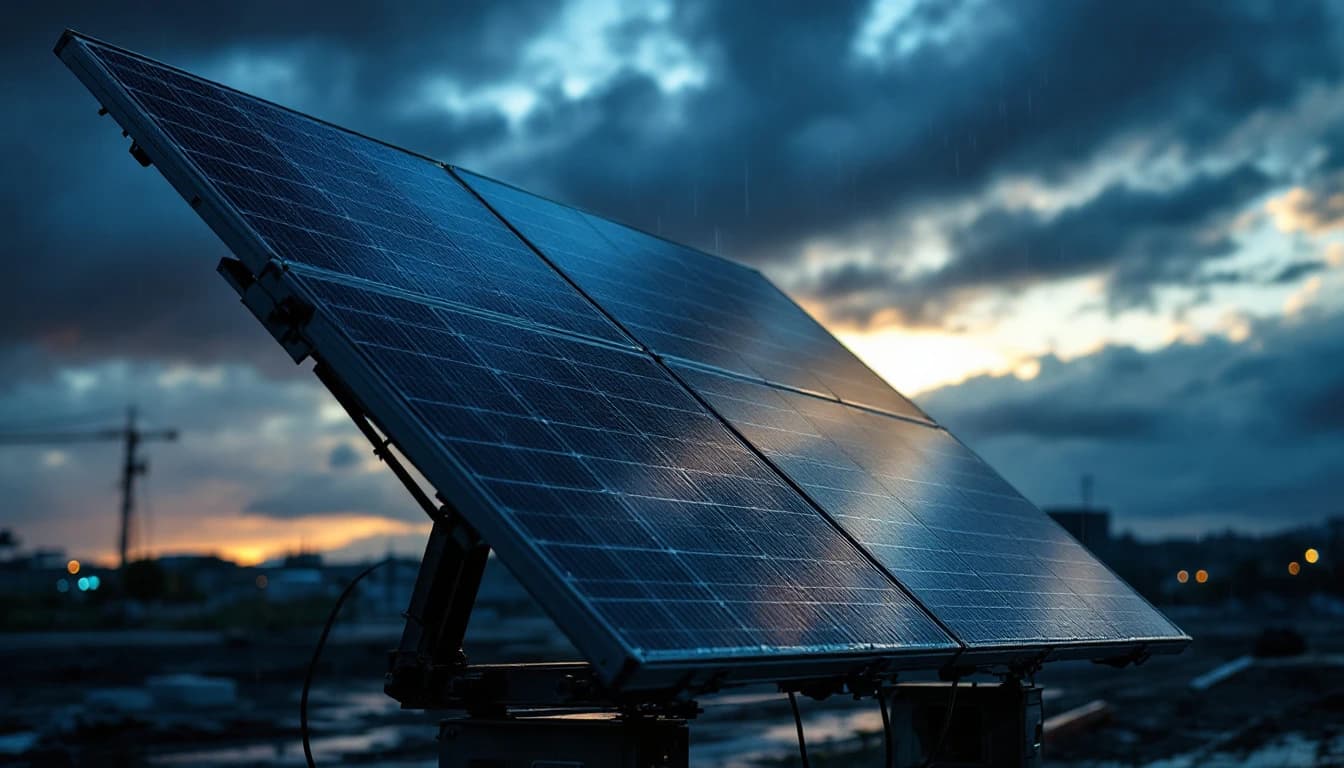
Direct answer: Solar security systems keep working through cloudy weather because they are engineered around it: the solar array is oversized for average conditions, a LiFePO4 battery bank stores multiple days of reserve, and power telemetry alerts the operator long before reserve runs low. Panels still generate meaningful power under overcast skies — reduced, not zero.
Clouds cut generation; they don’t end it
Photovoltaic panels produce from diffuse light as well as direct sun. Heavy overcast typically cuts output to a fraction of a clear day’s — a real reduction, which is why no serious system is sized assuming clear skies. North Texas also helps: DFW averages well over 200 sunny-to-partly-sunny days a year, and extended multi-day heavy overcast is the exception the battery bank exists for.
The battery is the real design center
The array’s job is to keep the battery bank topped up; the battery’s job is to carry the system through darkness and weather. LiFePO4 banks on SiteFortress units are sized for multiple days of autonomy at normal load. Chemistry matters: LiFePO4 handles Texas heat, deep cycles, and years of daily use in ways lead-acid systems don’t.
Telemetry turns weather into a non-event
Every unit streams battery voltage, charge percentage and solar wattage continuously. Falling reserve during a gray week is visible to our operations layer days out — and if a stretch of weather ever genuinely threatened uptime, we know before it happens and can intervene (load management, service visit) rather than discovering a dead unit after the fact. That operational loop, more than any panel spec, is what “solar powered” should mean in a security product.
The practical answer for site owners: cloudy weeks are ours to manage, not yours to worry about. The system reports its health; we act on it.
It is also the honest way to evaluate any solar security vendor: ask to see the power telemetry for a deployed unit in the week after a storm system. A provider who can show you battery curves has engineered for weather; a provider who changes the subject has a fleet of future dead trailers and no way to know which one is next.
What about hail, heat and Texas storm season?
North Texas weather tests hardware harder than clouds do. The panels on a deployed unit sit at a tilt that sheds most hail strikes at an angle, and panel glass is rated for impact in the same way rooftop solar is — while the electronics live in a sealed enclosure built for the 105-degree parking-lot summers that kill consumer hardware. Heat is actually the quieter enemy: it is the reason the battery chemistry is LiFePO4 rather than lead-acid, and the reason enclosure ventilation and battery telemetry get engineering attention that spec sheets rarely show. After a major storm cell passes through, unit health is verified remotely the same hour — and if something needs a service visit, we know before you do.
Frequently asked questions
What happens in a genuine worst case, like a week of storms during a Texas winter?
The operations loop, not the site owner, absorbs it. A genuinely bad stretch shows up in telemetry days early as declining reserve, and the responses escalate in order: load management to stretch the bank, then a service visit to top up or swap batteries if the weather refuses to break. The unit does not silently die and get discovered later — that failure mode is exactly what continuous power telemetry exists to eliminate, and it is the difference between solar-powered and solar-dependent.
Do the cameras and AI still run at full capability at night?
Yes — night is the design case, not the exception. The cameras run infrared and low-light modes, the AI classifies people and vehicles in those streams exactly as it does in daylight, and the deterrence stack of strobe, siren and talk-down is at its most effective in darkness. Power-wise, night is simply the battery half of the daily cycle the system is engineered around: the array recharges the bank by day, the bank carries the load by night, and telemetry watches the margin continuously.
Do solar security cameras still work when it is cloudy for days?
Yes — the system is engineered around exactly that. Panels keep generating meaningful power under overcast skies (reduced, not zero), the LiFePO4 battery bank stores multiple days of reserve at normal load, and power telemetry streams continuously so a long gray stretch is visible to the operator days before it could threaten uptime. Cloudy weeks are the operator’s problem to manage, not the site’s.
How many days can the unit run without any sun?
The battery bank is sized for multiple days of full autonomy at normal load, and genuine zero-generation days are rarer than they feel — even heavy overcast produces a fraction of clear-sky output, which extends the real-world reserve well past the nameplate number. DFW’s climate helps: extended multi-day heavy overcast is the exception the bank exists for, not the norm it fights weekly.
Why does the battery chemistry matter?
Because a Texas trailer bakes. LiFePO4 tolerates the heat that degrades lead-acid banks, survives thousands of deep cycles instead of hundreds, and holds usable capacity for years of daily service. Chemistry is the difference between a unit that quietly loses autonomy every summer and one whose reserve at year three still matches the design — which is why it is a design center, not a spec-sheet footnote.
Will anyone actually notice if the battery is running low?
Yes — before it matters. Battery voltage, charge percentage and solar wattage stream continuously to the operations layer, so declining reserve during a bad week generates intervention (load management or a service visit) days ahead of any outage. The failure mode this eliminates is the industry’s embarrassing classic: the dead trailer nobody noticed until after the break-in it slept through.
Does winter affect solar surveillance units in Texas?
Less than summer does. Shorter days reduce daily generation, but cooler panels actually convert more efficiently, and DFW winters keep generous sun between fronts. The design case remains the same: array oversized for average conditions, battery reserve for the exceptions, telemetry for the operator. Ice storms are handled the same way any severe weather is — remote health verification the same hour, service dispatch if anything needs hands.