Do talk-down speakers, sirens and strobes actually deter thieves?
October 10, 2026 · SiteFortress360
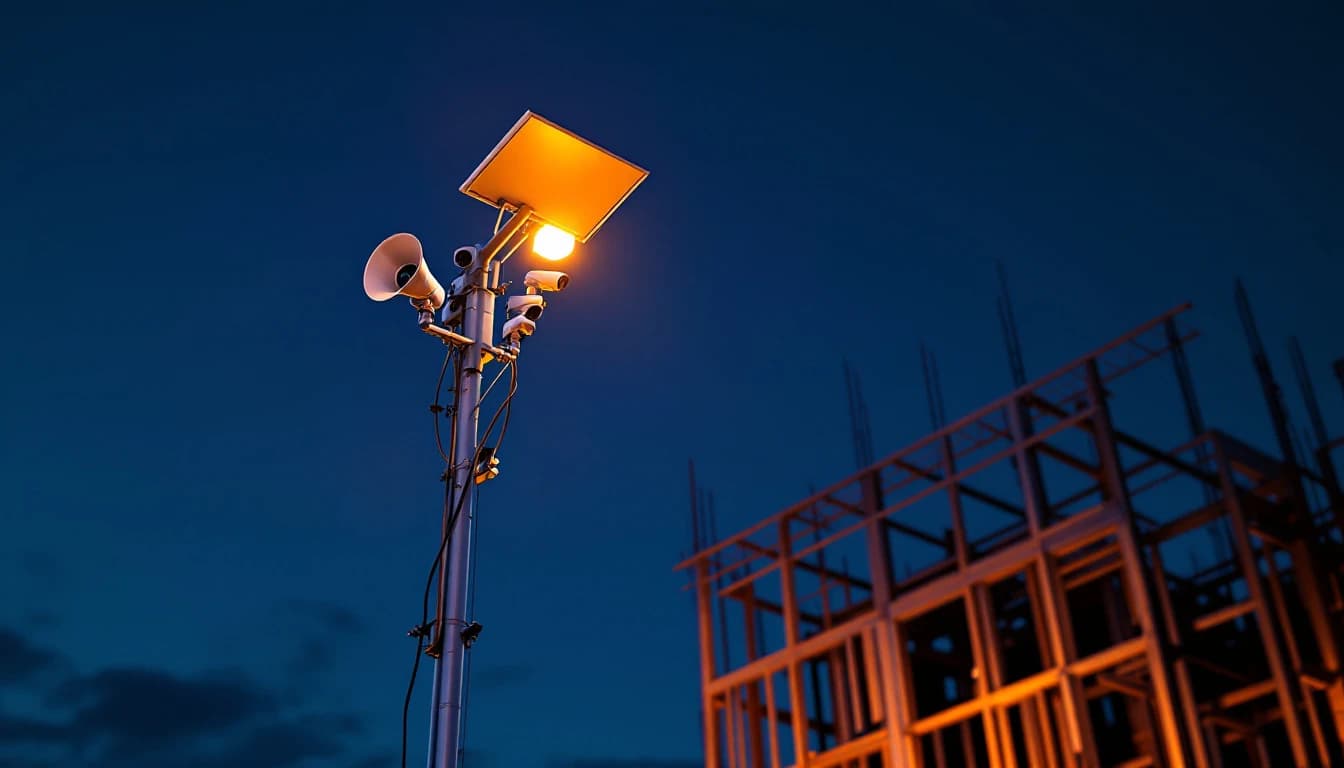
Direct answer: Mostly yes, against the people responsible for most jobsite losses: opportunists who chose your site because it looked unwatched. A strobe and siren fired by an accurate detection tell them they were seen before they touched anything, and a voice that describes what they are doing tells them they are being identified. Deterrence is weaker against a prepared crew that has already accepted being recorded. It is also only as good as the detection behind it, because a siren that cries wolf gets switched off.
What deterrence is actually trying to change
A person deciding whether to step over a fence is weighing three things: how much effort the job takes, how likely they are to be caught, and how quickly anything will happen. Cameras on their own mostly affect the second, and only if the person believes somebody will look at the footage. Audible and visible deterrence works on the third. It turns a consequence that might arrive next week into something that is happening now.
That is the whole theory, and it explains both where these devices work and where they do not. Someone who came because the site looked easy will usually leave when it stops looking easy. Someone who came with a plan, a truck and a time budget has already priced in the noise.
The three devices, and what each one is for
They are often listed together as though they were one feature. They do different jobs, and understanding the difference helps when you decide what should fire automatically and what should wait for a person.
- Warning strobe: silent, visible from a long way off, and the least disruptive signal that the site is live and something was detected
- Siren: removes any doubt, draws attention from outside the fence, and makes it hard to keep working
- Talk-down speaker: a voice, recorded or live, that addresses the person directly and is the only one of the three that proves someone is paying attention
What each SiteFortress unit carries
The hardware differs across the range, so check it against what you want the unit to do. The SiteFortress Mini carries a siren and strobe. The SiteFortress 360 carries an external siren and warning strobe, with a talk-down speaker where configured. The SiteFortress PTZ Pro carries an external horn and talk-down speaker with siren and strobe.
If spoken deterrence matters to you, that is a reason to look at the trailer units rather than the Mini, and a point to confirm when the configuration is agreed. The speaker is an output. It plays what the system or a person sends it. It is not a two-way intercom and should not be planned as one.
Automatic versus verified: the decision that matters most
There are two ways deterrence can be triggered. In the first, the on-board AI detects a person or vehicle in an armed zone and the unit responds by itself within moments. In the second, the detection goes to a monitoring workflow, a person confirms that it is a real intrusion, and then the response is sent.
Automatic is fast and costs nothing extra. Its risk is the 6 AM subcontractor, the surveyor who was not on the schedule, or the superintendent who came back for a laptop. Verified response is slower by the time it takes a person to look, and it comes with the 24/7 live monitoring add-on from +$499 per month, but it allows a voice that is specific. Being told that you, by the excavator, in the grey hoodie, are on camera is different in kind from a recorded warning, because it cannot be mistaken for a motion sensor.
Many sites split the difference: the strobe fires automatically on detection, because it is silent and harmless if the detection was a late worker, and the siren and voice are held for verified events or for the hours when nobody at all should be on site.
Why accurate detection comes first
Every experienced superintendent has worked next to an alarm that everyone ignored. A device that goes off for wind, rain, a stray dog or headlights sweeping across the fence trains the neighborhood, the crew and eventually the owner to treat it as background. After that it deters nobody, and it is usually silenced within a month.
This is why the detection layer matters more than the loudness of the siren. On-board AI that classifies people and vehicles, rather than reacting to any movement in the frame, is what makes it reasonable to attach a siren to a detection at all. Zones and schedules do the rest: the unit can ignore the public sidewalk, arm the laydown area after hours and leave the gate lane on a different timetable from the fence line.
Who it does not stop
There are three groups for whom noise and light are a weak answer. The first is the organized crew described above. They may still be pushed to hurry or to choose a less awkward site, but they are not surprised. The second is anyone with a legitimate-looking reason to be there, including a current or former worker in a vest, who will be recorded but may not trigger a response at all during working hours. The third is a person who is impaired or indifferent to consequences.
For those cases the value of the unit shifts from deterrence to evidence and response: clips recorded to local storage, an alert that reaches someone, and with monitoring, an escalation plan that defines when authorities are called. Published evaluations of camera schemes, summarized by the National Institute of Justice, point the same way. Results are strongest when surveillance is combined with other measures and visibly tied to a response, and weakest when cameras are simply installed and left.
Neighbors, noise and common sense
A siren does not know where the property line is. On an infill site with houses or apartments across the street, an automatic siren at 3 AM can produce a complaint to the city faster than it produces an arrest. Local noise rules differ from one municipality to the next across the Metroplex, and most have something to say about night hours, so it is worth a look at the ordinance for the city you are building in.
The practical controls are the ones already described. Use schedules so audible deterrence is restricted to overnight hours when the site is truly closed. Use zones so that the street and the neighbor’s driveway never arm anything. Prefer strobe-first on residential edges. And keep talk-down messages short and plain. A long recorded speech is more annoying to the neighbors than it is frightening to a trespasser.
There is a site safety point as well. Workers should know that the unit can sound, when it is armed, and who to call if they need to be on site out of hours. Sudden loud noise is a poor thing to introduce to someone on a ladder, and OSHA’s occupational noise guidance is a useful reminder that sirens belong to the hours when the site is empty.
Setting it up well
Most of the benefit comes from a handful of decisions made in the first week and revisited when the site changes.
- Write the working hours down honestly, including Saturday crews and early concrete pours, and arm around them
- Draw zones around what is worth stealing rather than around the whole lot
- Start with strobe on detection and add siren once you trust the alerts
- Decide who is allowed to disarm, and how a late worker asks for it
- If you add monitoring, write the talk-down script and the escalation order yourself
- Review a week of events after any change to fencing, stacking or access
How to judge whether it is working
The honest measure is not the number of alerts. It is what happens after them. In the event timeline, look for the pattern of a detection followed by a short clip of somebody leaving. Count how many overnight detections were real people as opposed to animals or weather, because that ratio is what keeps the siren credible. And compare losses over a full phase of the job rather than over a fortnight, since theft on a jobsite tends to follow deliveries.
If the unit is firing and people are staying, that is a sign you are dealing with the determined minority, and the answer is the next layer up: verified response, better physical locks on what they are after, or both.
Frequently asked questions
Is a talk-down speaker more effective than a siren?
Usually, when the voice is specific. A siren tells an intruder that something was triggered. A voice that describes what they are wearing or standing next to tells them a person is watching and that identification has already started. A generic recorded message is closer to a siren in effect, which is why live talk-down is tied to the monitoring add-on.
Does every SiteFortress unit have a talk-down speaker?
No. The SiteFortress Mini has a siren and strobe. The SiteFortress 360 has a siren and warning strobe with a talk-down speaker where configured, and the PTZ Pro has an external horn and talk-down speaker along with siren and strobe. If spoken deterrence is important for your site, confirm it when the configuration is agreed.
Will the siren go off every time a worker shows up early?
It should not, if the schedule reflects how the site really runs. Detection arms on the hours and zones you set, so an early pour or a Saturday crew is handled by adjusting the schedule. Many sites also set the strobe to fire automatically and keep the siren for verified events, which makes an unexpected early arrival a non-event.
Can the speaker be used to talk with someone at the gate?
Plan on it as one-way. The speaker plays recorded or live audio out to the site, which is what deterrence needs. It is not a two-way intercom for deliveries or visitors. If you need to let vehicles in remotely, the gate control add-on handles remote opening on compatible gate operators.
Will the noise cause trouble with neighbors or the city?
It can if it is set up carelessly. City noise rules vary across the Metroplex and most restrict night hours. Restricting audible deterrence to overnight periods when the site is closed, keeping the street out of the armed zones and using strobe-first on residential edges avoids nearly all complaints while keeping the deterrent in place.
Do thieves just ignore strobes and sirens after a while?
They ignore ones that fire for no reason. A device that sounds for wind and stray animals becomes background noise for everyone, including the people you want to scare. One that fires only on an accurate detection of a person or vehicle in an armed zone stays credible, which is why detection quality matters more than volume.