Drones over your site — what Remote ID actually tells you
August 30, 2026 · SiteFortress360
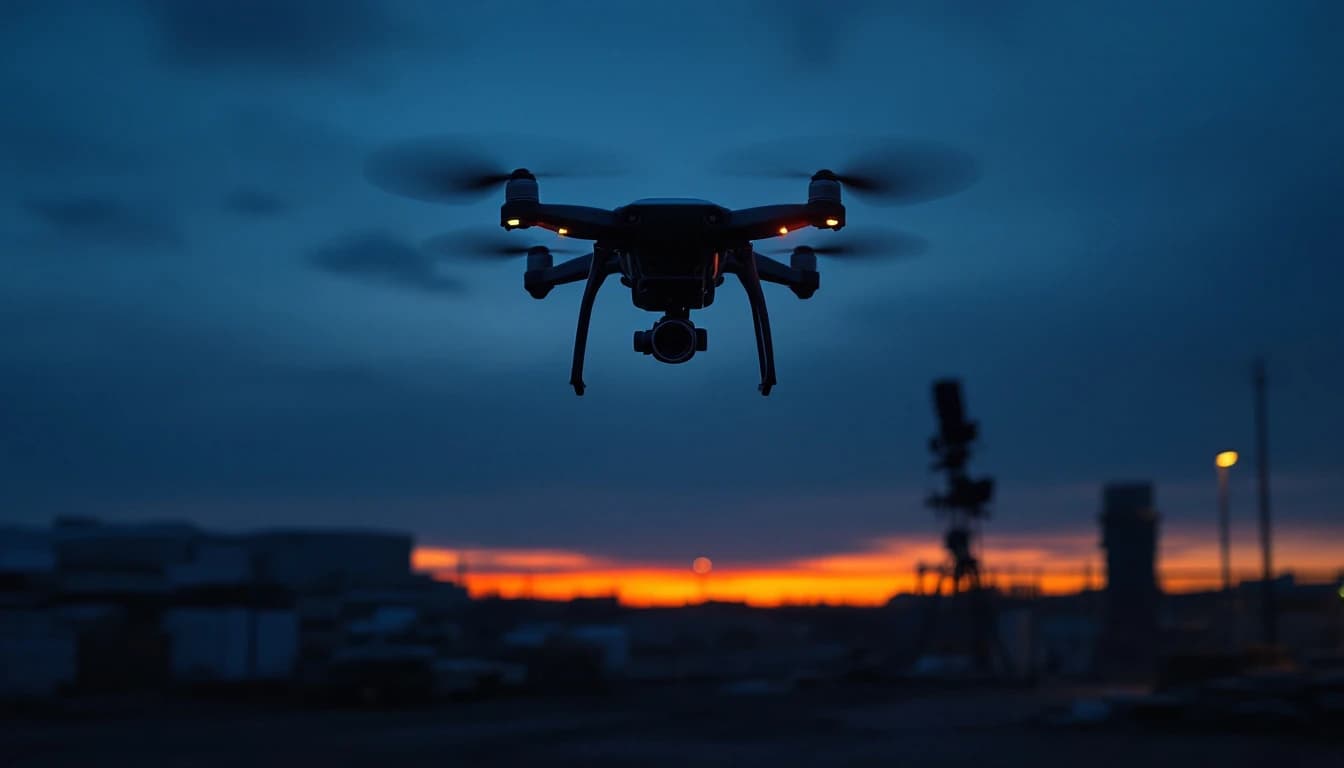
Direct answer: Most drones flying in United States airspace broadcast an FAA Remote ID signal, and a passive receiver on your site can listen for those broadcasts and log them — detection time, Remote ID details when available, and approximate position when it is broadcast. What it cannot do is see a drone that is not broadcasting, identify the person flying it, or do anything about it. Jamming, intercepting or disabling an aircraft is illegal, and no legitimate vendor offers it.
What Remote ID actually is
Remote ID is a Federal Aviation Administration requirement, not a security product. Drones operating in United States airspace generally must broadcast a radio signal identifying the aircraft and reporting position data — either built into the drone as standard Remote ID, or added through a broadcast module. The broadcast is deliberately local and open: it is designed so that anyone nearby with a suitable receiver, including the public, can hear it.
That design choice is the only reason site-level drone awareness is possible at all. Nobody is querying a national database or tapping a network. A receiver on your mast simply listens for broadcasts in the air around your property and writes down what it heard.
What a receiver on your site can log
The honest inventory is short, which is a feature rather than a limitation. What you get is a factual record of compliant drone activity near your property, timestamped and sitting in the same event timeline as your camera events.
- Detection time — when a compliant broadcast was heard
- Remote ID details as broadcast, when they are available
- Approximate position data, when the aircraft broadcasts it
- The event placed alongside your camera timeline for correlation
Why correlation is where the value sits
A drone log on its own is trivia. A drone log that sits twenty minutes before a fence-line detection turns an isolated camera event into a pattern, and a pattern is what makes an incident report worth reading.
That is also the fair way to judge the capability. It is not an air-defence system and it will not stop anything. It is one more honest column in the record you hand to a police officer, an insurer or your own leadership when you are explaining what happened and why you believe it was planned rather than opportunistic.
What it cannot tell you
A passive receiver hears what is broadcast and nothing else. A drone that does not broadcast a compliant signal — because it predates the requirement, was modified, or was built to avoid it — is not detected, and no vendor claim changes that. Radio conditions, distance, terrain and the site’s own metal all affect what actually gets received.
It also does not tell you who is flying. Remote ID identifies the aircraft; it does not publish the operator’s identity to the public. The pathway from a broadcast identifier to a named person runs through law enforcement and the FAA, not through your security dashboard — and that boundary is exactly what you should expect any vendor to describe accurately rather than blur.
What you are allowed to do about a drone over your site
Very little, and this is the subject on which the internet is loudest and most wrong. Drones are aircraft under federal law. Shooting one down, jamming its control link, spoofing it or taking it over are not grey areas: jamming equipment is illegal to operate, market and sell in the United States, and interfering with an aircraft carries federal consequences that dwarf whatever the drone was doing to you.
What you can do is document and report. Log the activity, keep the correlated camera footage, and hand a factual timeline to local law enforcement, who have established channels for suspected unauthorized operations. A clean record of repeated overflights preceding ground incidents is genuinely useful to an investigation. An angry account of a drone you shot at is useful to nobody, least of all you.
This is why our own add-on is described as passive listening and logging, and why we will not discuss interception, jamming or takeover with anyone at any price.
Why a scoping flight matters on a jobsite
The security concern is rarely the drone itself. It is what a drone makes cheap: a complete, current, overhead picture of your site — where the gate is unlatched, which corner of the fence is down, where the gang boxes sit, whether the laydown yard moved, whether anybody is actually on site after dark. That used to require a person walking your fence line and looking conspicuous. Now it takes four minutes and nobody sets foot on your property.
Two categories of site care most. Large construction projects with schedule-sensitive or competitive exposure treat overflights as progress espionage, which is a commercial problem rather than a criminal one. High-value yards, logistics facilities and industrial sites treat them as reconnaissance, which is a security problem. The response to both is identical: know it happened, know when, and keep it.
When the add-on earns its place, and when it does not
Drone awareness is the add-on we talk customers out of most often, because for the majority of sites it answers a question nobody has asked. A residential remodel, a small contractor yard, a single retail lot — none of these have a drone problem, and the +$99 per month buys a log nobody will read.
It earns its place when the site has airspace sensitivity or an observed pattern: repeat overflights the crew has already noticed, a project where overhead imagery has commercial value to somebody, or a facility whose security plan formally treats reconnaissance as a threat stage rather than a nuisance. If a superintendent has already said “there was that drone again”, that is the signal.
Every add-on in the catalog deserves the same test. License Plate Recognition at +$199 per month earns out on any site with vehicle traffic through a gate. Starlink at +$100 per month earns out where cellular is genuinely weak. Match the add-on to a problem you have actually observed and the money works; stack them by default and it does not.
Frequently asked questions
Can a security trailer detect drones?
It can detect compliant Remote ID broadcasts near the site using supported RF receivers, and log them with detection time, Remote ID details when available, and approximate position when the aircraft broadcasts it. That is detection of a broadcast, not radar. Drones that are not broadcasting a compliant signal may not be detected at all, and any vendor promising complete drone detection at a site-security price point is overselling.
Is it legal to jam or take down a drone over my property?
No. Drones are aircraft under federal law, and jamming devices are illegal to operate, market or sell in the United States. Shooting at, disabling, spoofing or taking over an aircraft exposes you to federal liability that will substantially exceed whatever the drone was doing to you. The lawful response is documentation and a report to local law enforcement, which is exactly what the logging capability is built to support.
Does Remote ID tell me who is flying the drone?
No. Remote ID identifies the aircraft and broadcasts position data; it does not publish the operator’s identity to the public. Connecting an identifier to a person runs through law enforcement and the FAA. What you hold is a factual, timestamped record of aircraft activity near your site, which is what an investigator needs from you rather than a name you were never entitled to have.
Why would anyone fly a drone over a construction site?
Legitimately, all the time — progress photography, survey work and inspections are routine and usually flown by somebody already on the project. The concerning pattern is not a single flight but repetition at odd hours with no known operator, particularly when it precedes ground activity. That is why the log matters more than any individual detection: one flight is noise, a pattern is intelligence.
Do I need drone awareness on a typical DFW jobsite?
Usually not, and we will say so before you buy it. Most single-building projects and small yards have no drone exposure worth $99 per month. It becomes worth adding when the crew has already noticed repeat overflights, when overhead imagery of the site has commercial value to a competitor, or when a facility security plan formally treats reconnaissance as a threat stage.
Does drone awareness require extra hardware on the unit?
It requires supported RF receiver hardware on the unit, which is why it is configured as an add-on rather than shipped on every deployment. Detection depends on both that hardware and on the drone actually broadcasting a compliant signal, so it is worth confirming coverage expectations for your specific site before adding it rather than discovering the limits afterwards.